The Merchant's Hesitation: How Trump’s Transactional Indecisiveness Empowered Iran and Doomed MAGA's Future
Contrasted Against the Warrior Ethos of Iran and Israel

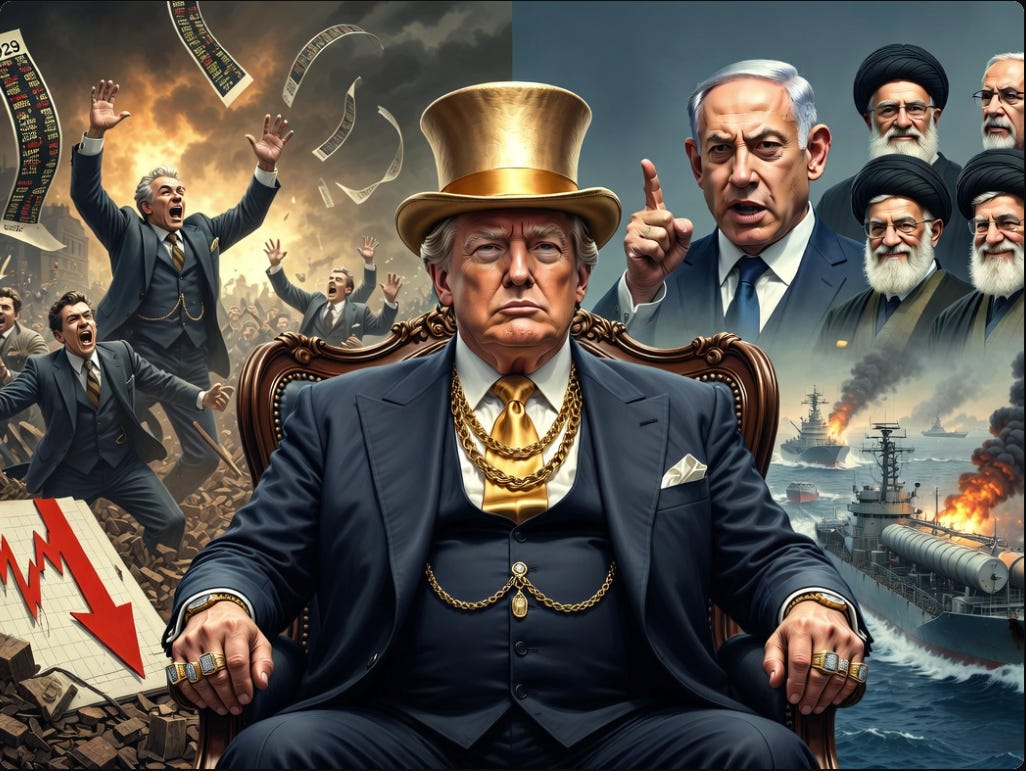
MAGA makes the case that Trump’s deal with Iran was his brilliant “art of the deal” tactic of making threats to coerce Iran into negotiating a good deal. One could make a case that this sort of worked in that Iran agreed to a deal because they didn’t want to be destroyed. However, this is a massive cope as Trump’s Iran deal is much more favorable to Iran than Obama’s deal, which Trump was obsessed with how bad it was. Not to mention that the deal is not set in stone and is already faltering due to Israel’s war in Lebanon with Iran snubbing JD Vance at the negotiations in Switzerland, and threatening to close the Strait of Hormuz again and retaliate against Israel.


Iran gained escalation dominance because Iran has a warrior ethos of willing to take pain. All Iran had to do was hold in there and just not surrender. Iran was punished for making a reasonable deal but was rewarded with a more favorable deal for fighting back. In contrast, Trump as the merchant freaks out over any sign of a stock market downturn, much like he did with the tacos on tariffs. Basically, Trump is using the stock market to determine war decisions, besides the likelihood of insider trading. Past presidents may have done similar things but they weren’t as blatant about it or tweeting it. America’s negotiators, like Steve Witkoff, are basically salesman types while Iranian negotiators are more strategic warrior archetypes with some priest elements.


America is a decadent empire that worships mammon while Iran is an ancient civilization with a warrior ethos who triumphed over America despite America having a much more powerful military and GDP. Overall, Iran is in a much stronger position than before the war which was a colossal strategic blunder. The war could also still lead to the gradual weakening of the American empire, as Gulf bases will likely close and the petrodollar arrangement is basically over, as the geopolitical sphere of Iran, Russia, and China becomes more powerful.


Whenever Iran retaliates or threatens retaliation against the Gulf, the markets start to crash. For instance, when Iran attacked that apache helicopter and Trump threatened retaliation, it scared the market so he canceled his retaliatory strikes. Much like with his previous threat to wipe Iran off the face of the earth that was followed by the ceasefire. While the US could have hypothetically destroyed Iran, Iran has their Samson option for the Gulf, which would cause a global depression. Iran doesn’t really need a nuke anymore because controlling the Strait of Hormuz is a more powerful weapon. If they don’t get their way from now on, they can just threaten the Strait with their cheap drones, as well as having the Houthis attack the Bab el Mandeb Strait.


While it looks like Iran is closing the Strait again, let’s just say the deal is successful. The deal can delay an economic crash and ease oil prices for the shot term but even if the Strait successfully re-opens, energy reserves are getting depleted, there is still a backlog of oil shipments, damaged oil infrastructure, navel mines that have to be removed, and insurance rates on shipping that will be high until ship safety is guaranteed, all of which could take several months, if not longer. The reason the stock market is not crashing is that the reality is so bad that speculators refuse to factor in fundamentals, as we as all the liquidity regarding the upper class having so much wealth that they don’t know what to do with it, so they just put it all into stocks. An economic crash would be karma for Trump’s worship of GDP and the stock markets, as Trump’s initial main political strength was the economy.


Even if Trump hates prolonged war, he was still stupid enough to let the more virile warrior, Netanyahu, trick him into what he thought was going to be a short excursion. Trump ultimately let the economic pressures dictate his decision to end the war and capitulate to Iran, to the chagrin of Israel and the neocons, which is a contradiction of his previous groveling to Israel. As strong as Zionist influence is, economic pressure and the GDP worship cult are a much greater force, as the war continuing with the Strait remaining closed passed Labor Day would cause a global great depression, which is still a possibility. Trump has even been making statements that sound favorable toward Iran, which just shows how transactional he is. Israel is trying to sabotage the deal by escalating with Hezbollah in Lebanon. The question is how confident is Israel that the US will protect them from Iran if Israel escalates with Iran again. Since Trump has such a massive ego, there is a chance he will throw Israel under the bus out of spite for destroying his legacy, but also that he escalates with Iran again out of frustration, as he is making threats against Iran again.


Netanyahu is a parasite to America and genocidal to Palestinians, Lebanese, and Iranians, but he has a warrior ethos in how he is not transactional like Trump. Rather he has this existential will to fight to the last drop of blood to defend his nation and bloodline, even if it is subsidized by the American tax payers. Whether he would settle down if US subsidies and military protection ended is a topic for a separate article. Regardless, Netanyahu behaves like a king from the Old Testament while Trump is like a late 19th century robber baron. The warrior lives for war while the merchant views war as transactional, such as an opportunity to profit. While inside trading is the most cynical take, a slightly less cynical take is just that Trump is not a long term planner and is very transactional, depending on a particular circumstance. Ironically, Trump said that he doesn’t care about Americans’ financial hardship, which appears the polar opposite of using economics as the main metric. He was reacting to frustration over the war failing and it was a sign of his declining cognitive capacity in which he lacks any filter, so his callousness shows.


Ronald Reagan was also a merchant type obsessed with tax cuts, deregulation, “supply-side,” with a salesman pitch of optimistic capitalism, but he also had a warrior flair in his Cold Warrior rhetoric. George H. W. Bush leaned warrior due to his military background and he also had some merchant traits but he was more just establishment than any pure archetype. Bill Clinton was the most purist merchant, “It’s the economy, stupid,” with his deal-making and personal charisma over ideology. G.W. Bush despite being a draft dodger, was a warrior with some priest elements, such as moralistic rhetoric on foreign policy and a merchant on his neoliberal economic policies. Regardless, his presidency and its downfall was defined by militarism and endless war, which Trump is desperate to avoid.
Barack Obama epitomized the priest archetype, albeit a liberal academic version, with moralistic narratives like “hope and change,” the arc of history, and an identity/values focus. Obama was the professor in chief. Joe Biden had some priest elements in moralistic framing about the threat to democracy but like Bush Sr. he was more just an establishmentarian and institutionalist, which doesn’t fit neatly into these ancient archetypes. While I am personally more of the priest archetype, that archetype is not inherently good, as moralistic narratives conceal power, woke came from the Brahmins of academia, and bureaucracy can mirror the structure of the Catholic church, albeit corporations are also very managerial.
Despite Trump attending military school as a boy, he is a merchant in his businessman persona and negotiation tactics, “art of the deal,” albeit like Reagan, a warrior in some of his rhetoric like America First and his confrontational decorum. Trump’s commerce secretary, Howard, Lutnick, is probably the best example of a pure merchant type. A merchant like Bill Clinton may have been ok in a time of great peace and prosperity but that archetype is terrible today in a time of existential civilizational crisis.
Trump was more of a warrior as a candidate, such as after the failed assassination attempt, when he put his fist up in the air and chanted “fight, fight, fight.” Trump was a warrior in that particular iconic moment but he failed to bring that energy and fighting spirit into his presidency. It doesn’t help that he is old with terrible health and cognitive decline. You could make a case that the ICE raids are the closest to a warrior ethos of Trump’s presidency but even that is performative, like one of Trump’s reality shows or his Idiocracy-like UFC match at the White House. MAGA views Trump as a warrior king and even the Alt-Right had their God Emperor Trump meme which looking back is cringe. Even the Alt-Right lacked enough skepticism over Trump being a salesman because of how exciting it was to have an apparent outsider rise up and humiliate the establishment, as an anti-Priest disruptor.
Trump represents the worst of the merchant archetype in his extreme gluttony and greed with minimal noble traits. I am saying this as someone who supported Trump back in 2016. This explains why Trump backed down from taking a lot of bold positions like shutting down the BLM riots and recently backing down on tougher visa requirements for immigrants. I remember when Trump visited a military cemetery and said that those who die in war are losers and suckers. As a merchant, he doesn’t see value in honor nor anything that doesn’t make you rich or get you pussy. Trump’s one bold risk on the war with Iran was because of financial donations from pro-Israel donors like the Adelsons, thus the warrior is a slave to the merchants.
Trump is a salesman who saw a unique niche to appeal to an untaped market for nationalism and populism that the existing GOP neglected. Thus, MAGA became a product to sell under capitalism, much like Trump selling merch to his cultist fans at rallies, rather than about defending blood and soil. Even though oligarchs generally support mass immigration for cheap labor, you get these transactional alliances between capitalists and nationalists. For instance, Marc Andreeson pivoted on his support for h1b visas because the same people who oppose mass immigration within MAGA also agree to de-regulate tech while the Left supports both regulation and immigration. However, I could see these rightwing tech elites easily switching back, if say a president Newsom was pro-h1b and friendly to big tech on regulation. Likewise, the MAGA communism meme, in which MAGA was encouraging economic sacrifice for America’s long term national greatness, wasn’t breaking from that merchant archetype. Rather, it was just another cynical marketing gimmick for his chump supporters to accept economic hardship while Trump insiders become rich from market manipulation over going taco.
