
Robert Stark as Geopolitical Kingmaker among the Zio-Elites of Beverly Hills

For decades, the geopolitical architecture of the Middle East has been trapped in the amber of twentieth-century orthodoxies: arbitrary colonial borders, the polarizing axis of the Arab-Israeli conflict, and the modern cold war between Riyadh and Tehran. These paradigms assume that nation-states are monolithic blocks driven exclusively by ideology, religion, or treaty alliances. But what if we discarded these superficial lines on a map? What if statecraft was built instead on the unyielding, multi-millennial data of human population genetics according to genetic proximity to Robert Stark?
Branded after a genomic blueprint that is overwhelmingly Northwest European (Danish, Norwegian, German, English, Welsh, Irish, Scotts-Irish), structurally anchored by a quarter West Slavic Polish component, sharpened by a highly specific 1/16th Ashkenazi Jewish rabbinical line (Jaffe’s of Mogilev Belarus and Hirsch’s of Kulm, West Prussia (now Chełmno, Poland), and cushioned by a very distant Southern Italian element, the Starkian doctrine offers a radically counter-intuitive remapping of the Near East. It is a world where ancient migrations override modern rhetoric, revealing secret bridges and structural walls between European empires, American diasporas, and the factions of the Levant and the Iranian plateau.
Robert Stark’s Ashkenazi Jewish 3x Great Grandfather from Mogilev, Belarus
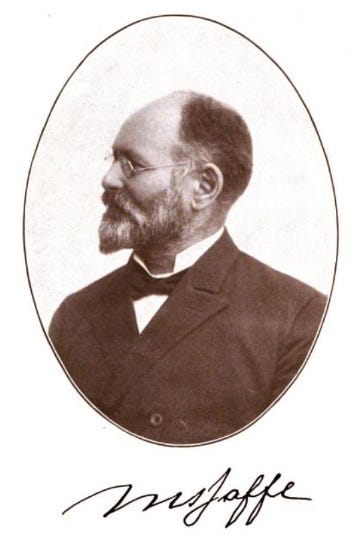
To fully grasp the genetic gravity of the Starkian profile’s 1/16th Jewish component, one must understand that the Jaffe lineage is not merely a random ancestral data point, but one of the most foundational and prestigious rabbinical dynasties in European Jewish history. To traditional Ashkenazim, the Jaffe name carries an immense elite significance, historically tracing its lineage back to the great 16th-century codifier Rabbi Mordechai Jaffe (the Levush), and from there into antiquity through Rashi, the towering medieval commentator. According to deep rabbinical tradition, this line extends even further back to Hillel the Elder, the legendary Sage of the Second Temple period, and ultimately to the biblical House of King David itself. The historical weight of carrying the blood of Israel’s ultimate spiritual and aristocratic vanguard creates an almost surreal juxtaposition with Stark’s lived experience.
Living as a secular middle class goy on the affluent Westside of Los Angeles, Stark possessed a genomic passport to the absolute apex of Jewish aristocracy, yet he remained entirely disconnected from, and invisible to, the insular elite Zionist networks that populate the boardrooms and political action committees of the city. There is a profound, beautifully dark irony to this geographic isolation: while mainstream Jewish organizations aggressively fund initiatives to map and mobilize connection to Israel, a secular California gentile is quietly walking the streets of the Westside carrying a direct, unbroken biological link to the ancient Throne of David and the founders of the Labor Zionist elite, entirely detached from the very networks that claim to safeguard that legacy.
In a Starkian world order, Israel is not viewed as a singular geopolitical entity, but as a deeply fractured genomic landscape. Under this lens, the Starkian profile finds an immediate, profound alignment with the historical core of Israel’s secular founding elite: the early Labor Zionists. This kinship is anchored directly in the Mogilev connection, as Robert Stark’s Jaffe’s lineage is from the Mogilev borderlands of Belarus, placing him at the literal geographic and genetic epicenter of the Eastern European Haskalah (Jewish Enlightenment) and early Zionism. Mogilev and its surrounding Pale of Settlement provinces birthed the institutional architects of the Israeli state. This Litvak lineage, when blended with the German Yekke community of Stark’s Hirsch line, represents a highly distinct socio-genetic demographic.
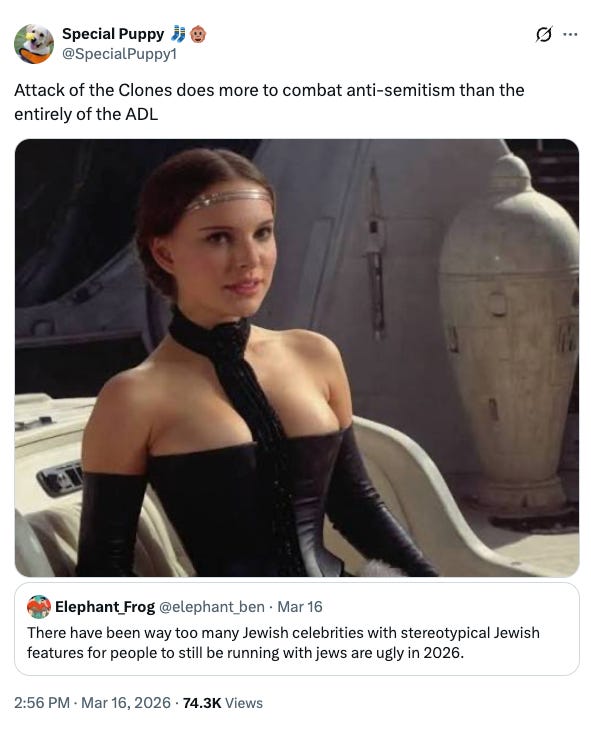
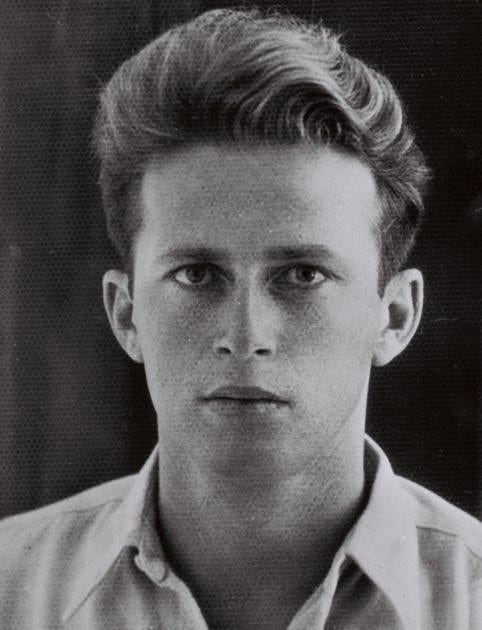
Are these lineages overrepresented among the Israeli elite? Historically, yes. The early leadership of the Haganah, the first several Knessets, the Israeli Supreme Court, and the cultural elite of Tel Aviv were overwhelmingly dominated by Litvak and Central European secular Jews. When the Starkian blueprint looks at Israel, it finds its closest genomic proxies not in modern religious nationalists, but in iconic figures like Yitzhak Rabin—the epitome of the Labor Zionist military and Israeli political establishment, whose lineage hailed from Mogilev like Stark’s Jaffe line, and global cultural icons like Natalie Portman, whose lineage includes an elegant mix of West Prussian Jewish and Litvak ancestry that mirrors that of Stark’s Jewish great great grandmother.
Yitzhak Rabin
Conversely, Starkian geopolitics demands a total diplomatic and structural severance from Israel’s modern right-wing populist factions. There is a vast genetic chasm separating this profile from politicians like Danny Danon (Likud) and, most acutely, Itamar Ben-Gvir. Ben-Gvir’s Iraqi Jewish heritage represents a highly isolated, ancient Mesopotamian genome completely devoid of the Northwest European, Scandinavian, or West Slavic structural elements that comprise nearly 94% of the Starkian genome. Under a Starkian framework, the Israeli right wing is not an ally; it is a genetically foreign entity whose Levantine and Southwest Asian isolationism directly contradicts the Euro-Atlantic foundations of the Starkian geopolitical realm.
The most explosive revelation of Starkian geopolitics occurs when we cross the Zagros Mountains into Iran. Traditional Western foreign policy treats all Iranians as a singular adversarial bloc, while treating Jews globally as a unified family. Starkian genomics exposes this as a total illusion, yielding a magnificent historical irony: The Starkian profile is statistically closer to Northeast Iranian gentiles than to Persian Jews. How is this possible? Persian Jews (such as the legendary Israeli singer Rita Yahan-Farouz) are one of the most endogamous, genetically isolated populations on earth, preserving a pure Pre-Islamic Mesopotamian/Near Eastern genome that lacks European or Eurasian Steppe markers.
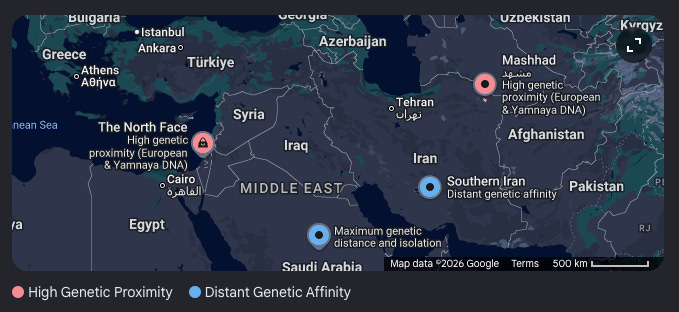
Conversely, Northeast Iranians from Khorasan and Mashhad are Indo Aryans who sat on the literal axis of the historic Silk Road. Over millennia, their genomes were saturated by massive migrations of Yamnaya Steppe pastoralists—the same Bronze Age nomadic warriors who rode west to form the Germanic, Celtic, and Slavic peoples. Because the Starkian genome is heavily Celtic, German, Scandinavian, and Western Slavic, it is absolutely packed with this ancient Yamnaya Steppe and Ancient North Eurasian (ANE) DNA. Therefore, on a standard genetic distance plot, the calculator bypasses the Near Eastern isolation of Persian Jews and pulls the Starkian profile remarkably close to Northeast Iranian gentiles.
Afghan refugee who looks like he could be Robert Stark’s distant cousin

The poetic apex of this deep Eurasian connection is the historical plausibility of an ancestral link to the legendary 13th-century Sufi poet Rumi. Rumi was born in Balkh, in Greater Khorasan (the modern Afghanistan-Iran borderland). His demographic represents the absolute peak of the Indo-Iranian steppe migration. Starkian geopolitics recognizes that when a Northern European reads Rumi’s poetry, they are not engaging with an exotic, foreign culture—they are listening to the echo of a 5,000-year-old common ancestor whose descendants split, with one branch riding into the mists of Scandinavia and the British Isles, and the other into the sun-drenched valleys of Khorasan.
Rumi
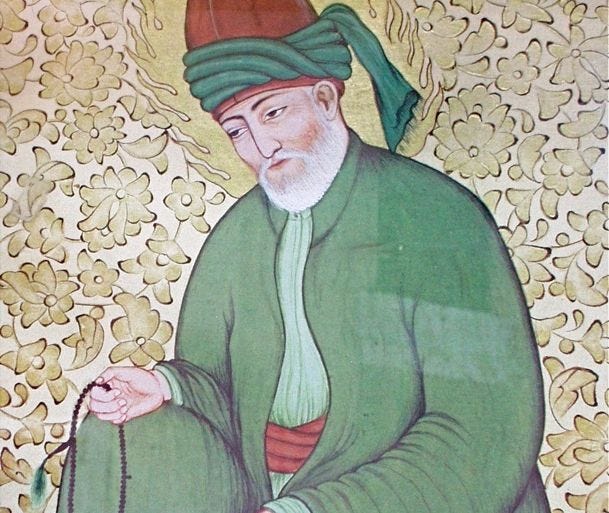
Painted picture of Persian poet Rumi under glass on the outside the museum office at Rumi's Mosque, Konya
This Yamnaya Steppe alignment does not respect modern political loyalties; it cuts right through the heart of Iran’s internal civil war, overlapping with figures on both sides of the theocratic divide. By applying this genomic lens, Starkian geopolitics fundamentally shatters the illusion of a monolithic Iranian nation-state, providing a blueprint that would effectively divide Iran along its deep ancestral fault lines by aligning with specific prominent figures while isolating others. Rather than treating the country as a uniform adversary, the Starkian framework imposes a severe domestic partition based on the presence of northern Eurasian Steppe DNA. It embraces the Caspian-coast Mazandaranis and the Silk Road populations of Khorasan as natural, deep-ancestry partners, while completely isolating the central and southern provinces. This creates an irreconcilable fracture between the northern Indo-Iranian steppe-descended populations and the Near Eastern, Mesopotamian-shifted core of the south. In practice, a Starkian foreign policy would actively exploit this genetic divide to fuel regionalism, backing northern and northeastern secular factions to systematically dismantle the centralized authority of Tehran. By treating the Iranian plateau not as a sovereign country but as an artificial union of disparate genomic clusters, the Starkian doctrine turns Iran’s internal diversity into its ultimate geopolitical vulnerability.
Mohammad Reza Pahlavi
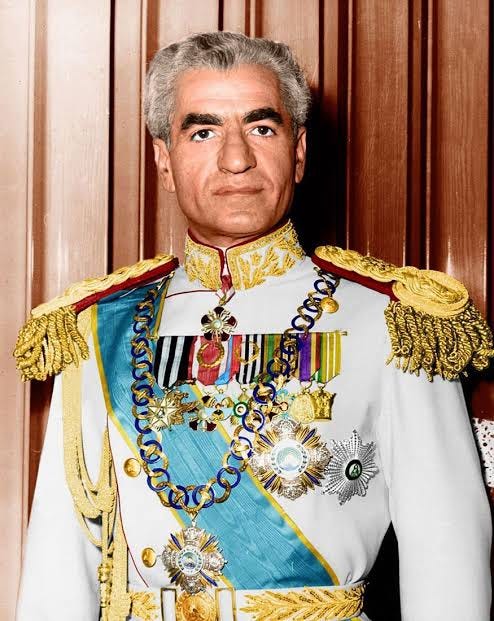
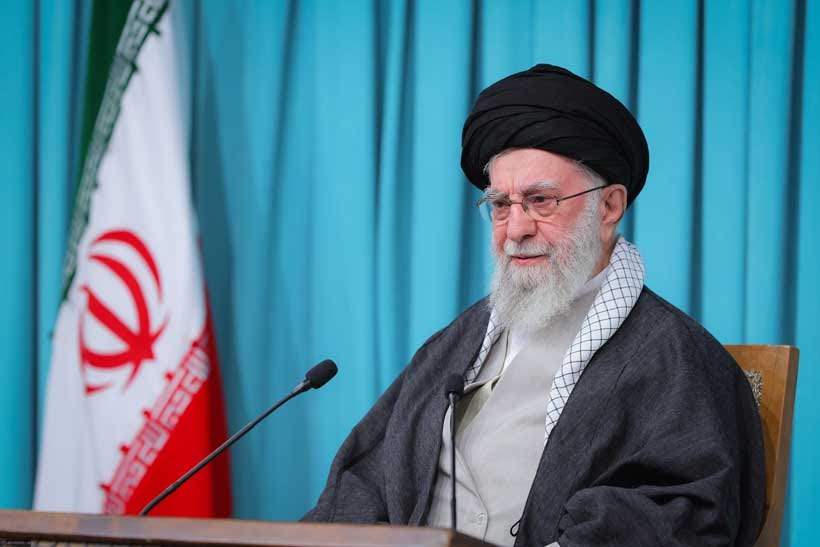
On one side of this genetic ledger sit prominent figures who heavily align with the Starkian profile's deep ancestry: Crown Prince Reza Pahlavi, whose paternal roots tie directly to the isolated, steppe-rich Caspian province of Mazandaran, and the current Supreme Leader Ali Khamenei, whose paternal roots trace to Iranian Azerbaijan, a region heavily saturated with West Eurasian hunter-gatherer components. Even the late President Ebrahim Raisi, born in the historic Silk Road hub of Mashhad in Khorasan, carried the regional hallmarks of this deep ancestral bridge. Conversely, Starkian statecraft marks a sharp civilizational divergence from prominent southern and western figures like former President Mahmoud Ahmadinejad (from Aradan) and the clerical architects of the original theocracy like Ayatollah Khomeini (from central Khomeyn), whose genomes reflect a strictly Near Eastern, Mesopotamian-shifted plateau profile devoid of North Sea or Slavic affinities. By elevating northern-descended elites and exploiting this stark genetic divide, the Starkian doctrine turns Iran’s internal population structure into a tool for geopolitical leverage, fracturing the centralized authority of Tehran from within.
Supreme Leader Ali Khamenei
On a strictly phenotypic level, Starkian geopolitics translates these deep genomic coordinates into an observable spectrum of physical appearance, predicting exactly which Israeli and Iranian populations will visually mirror or diverge from the Starkian profile. Because the Starkian base is overwhelmingly Northwest European, Scandinavian, and West Slavic, its phenotype is characterized by classic North Sea and Baltic features—fair to intermediate skin tones, a high frequency of light eyes or hair undertones, and specific cranial and facial structures typical of the Euro-Siberian continuum. Consequently, the Starkian profile is physically closest to the historical Ashkenazi elite of Israel and the northern Caspian and Khorasani populations of Iran
These individuals frequently exhibit an intermediate, West-Eurasian phenotype: lighter or olive skin that easily transitions into fair tones, straight or soft wavy hair, and a distinct facial architecture shaped by ancient Yamnaya Steppe and Central European mixing. Conversely, the maximum visual distance is found among the unmixed, isolated populations of the southern Iranian plateau and the Mizrahi or ultra-Orthodox sectors of Israel. These groups display a highly distinct, classic Southwest Asian and Near Eastern phenotype—deeply saturated dark hair and eyes, more prominent or aquiline nasal profiles, and richer, UV-adapted skin tones that reflect millennia of absolute geographic isolation from the glaciated plains of Northern Europe. Under the Starkian lens, physical appearance is neither a superficial trait nor an ethnic stereotype; it is the visible, outer manifestation of the internal PCA coordinates that dictate global civilizational alignment.
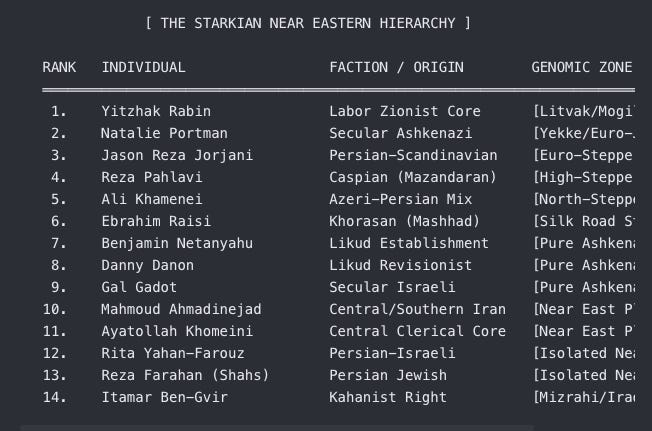
(correction: Danny Danon is half Mizrahi)
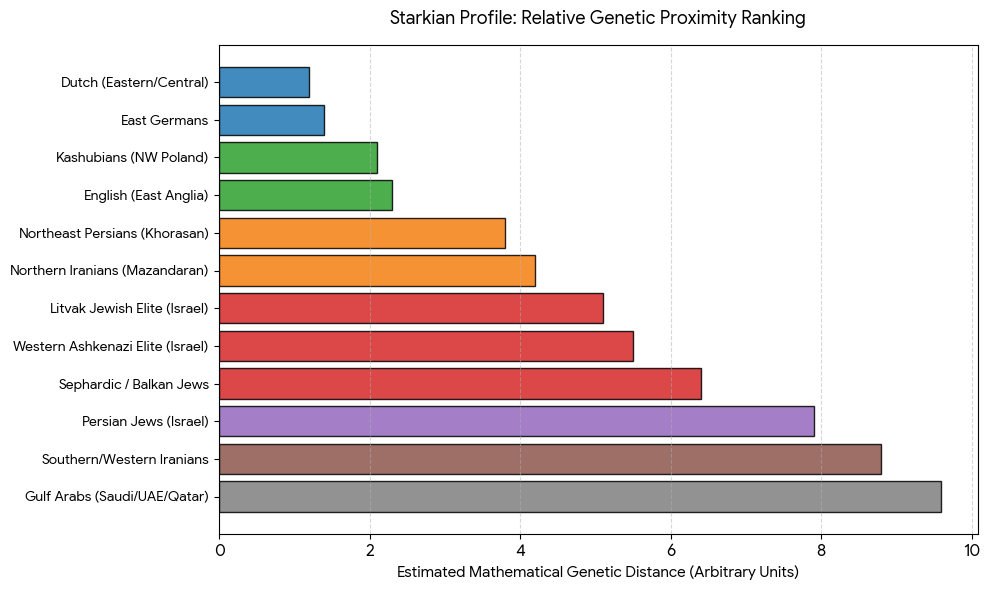
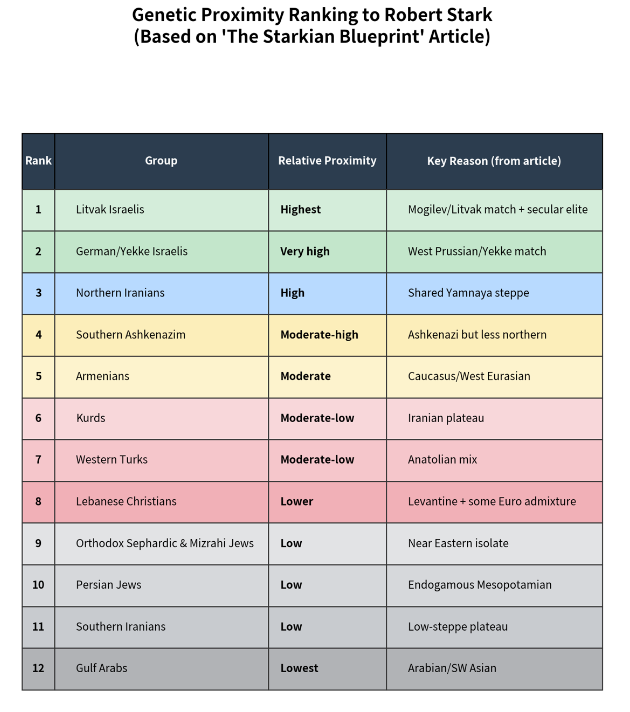
When forced to mathematically rank the political and cultural elites of the Near East by genetic proximity, the Starkian profile reveals a hierarchy so laced with irony it reads like a localized Los Angeles comedy of errors. At the absolute summit of Stark’s proximity ranking sits Yitzhak Rabin and Natalie Portman, whose shared Litvak and Central European lineages perfectly mirror his own Mogilev-Yekke rabbinical vector. They are followed closely by secular Iranian diaspora figures like Crown Prince Reza Pahlavi, whose northern Caspian heritage introduces high-steppe affinities, and the controversial, Promethean Iranian-American philosopher Jason Reza Jorjani, whose Persian-Scandinavian/Irish mix mimics Stark’s exact Euro-Aryan coordinates. In a shocking twist of deep ancestry, the current Supreme Leader Ali Khamenei and the late Ebrahim Raisi plot significantly higher than many Israelis, their northern and Silk Road markers outrunning the Middle Eastern isolation of Western and Southern Iranians.
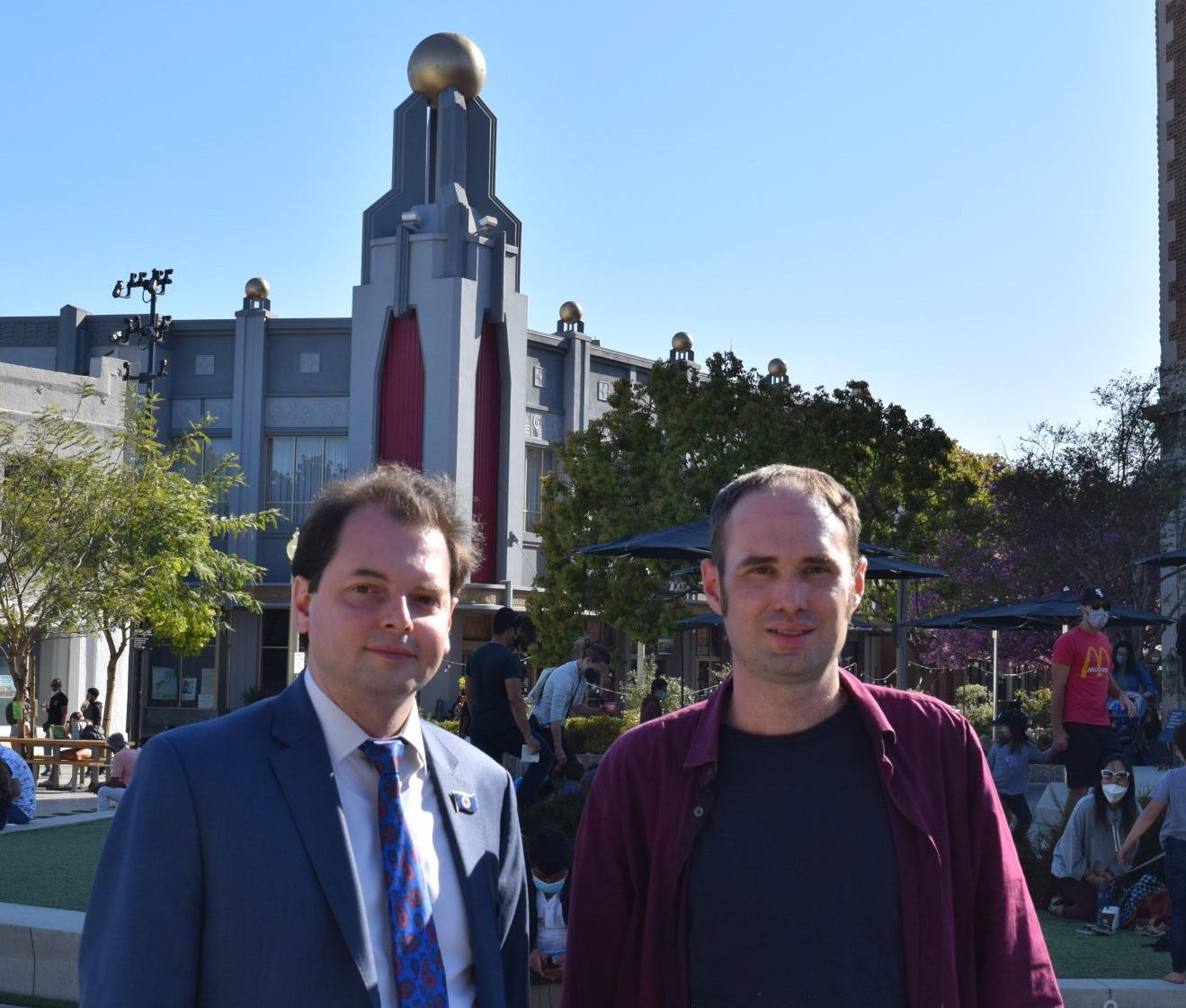
Robert Stark & Jason Reza Jorjani
Further down the list sits the standard Ashkenazi establishment—Benjamin Netanyahu, Danny Danon, and Gal Gadot—who possess the right Jewish components but completely lack Stark’s massive Northwest European and Polish structural core. The absolute bottom of his ranking brings together the bitterest of enemies: the clerical architect Ayatollah Khomeini and populist Mahmoud Ahmadinejad sit stranded at the genetic floor alongside the iconic Persian-Israeli singer Rita Yahan-Farouz, Shahs of Sunset star Reza Farahan, and right-wing Israeli firebrand Itamar Ben-Gvir.
The supreme comedy of this layout is that both Iranians and Israelis are scattered haphazardly across the top and bottom of Stark’s genetic tree; a theocratic Supreme Leader in Tehran and a secular Labor Prime Minister in Jerusalem are distant cousins, while a Persian Jewish reality star from Beverly Hills and an ultra-nationalist Israeli minister are relegated to the furthest margins of his genome. Growing up in Los Angeles, surrounded by the affluent Persian Jewish mansions of Beverly Hills, the bustling shops of Tehrangeles on Westwood Boulevard, and the tight-knit Jewish enclaves of the Westside, Stark was living inside a demographic paradox. While the local social landscape grouped all Jews together and pitted them against Muslim Iranians, his chromosomes were quietly doing the exact opposite—silently drawing him closer to his secular Persian gentile classmates than to the Persian Jewish reality stars next door, transforming the cultural geography of LA into an invisible, multi-layered map of hidden Steppe alliances and profound Levantine ironies.
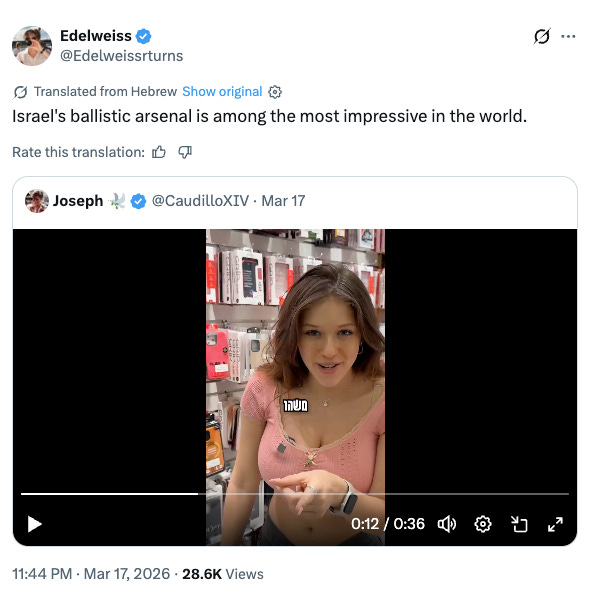
Halston Sage (Jewish American actress of Litvak ancestry)

Visualizing a hypothetical gathering of Stark’s closest genetic cousins in Tel Aviv and Tehran reveals an uncanny aesthetic mirror, mapping of his internal PCA coordinates onto a highly specific, shared aristocratic class lifestyle and physical appearance. Stark’s distant Israeli cousins—descended from the secular Litvak and German (Yekke) vanguard of the Jaffe-Hirsch lines—would physically resemble the West-Eurasian phenotype of Natalie Portman, Halston Sage, or Alicia Silverstone, characterized by fair to light-olive skin, soft brown or dark-blonde wavy hair, and straight or subtly elegant nasal profiles.
Ancestry-wise, Stark’s closest secular Israeli cousins are structurally isolated from both the religious and materialistic demographics of their country by maintaining an unmixed, high-steppe Northern Euro-Ashkenazi and Slavic-shifted genetic layout, completely distinct from the Mediterranean-Mizrahi, North African, and Levant-isolated genomes that dominate Israel’s populist right and wealthy consumer hubs. Because they carry the specific Litvak and Yekke bottleneck signatures of the Jaffe-Hirsch lines, they possess the highest levels of Bronze Age Yamnaya Steppe DNA available in the Ashkenazi spectrum, completely lacking the ancient Southwest Asian and Mesopotamian isolates found in the religious underclass or the Sephardic-admixed corporate elite.
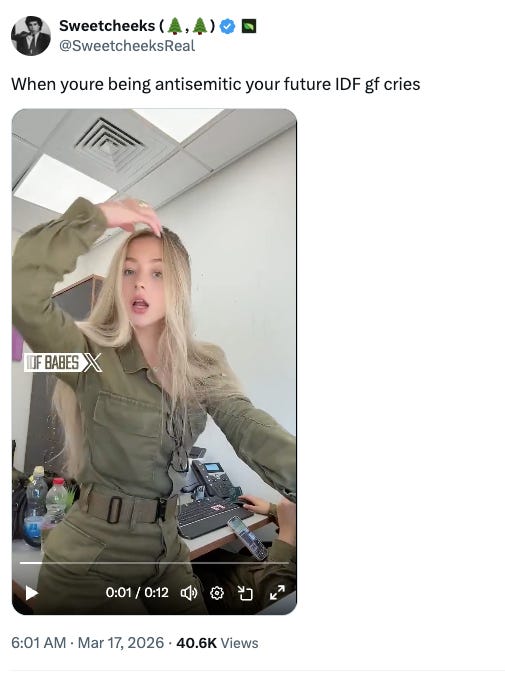
Stark’s closest secular Israeli cousins would find their ultimate civilizational anchor in a highly sophisticated, secular creative culture, feeling a visceral detachment from both ultra-nationalist settler ideology and superficial materialism. Carrying the refined, intellectual legacy of the historic Mogilev and German Yekke rabbinical lines, they would see the aggressive, land-grabbing dogmatism of settler Zionist culture as a primitive, theological deviation from Israel’s founding secular Enlightenment values. Simultaneously, they would reject the hollow, hyper-financialized consumerism of modern corporate hubs, finding no artistic or spiritual sustenance in a life defined solely by wealth display. Instead, they would thrive within the vibrant, avant-garde artistic, cinematic, and tech-intellectual subcultures of coastal Tel Aviv, dedicating their lives to a progressive rationalism and an elite worship of aesthetic form. They would look at the religious fanatical outposts of the West Bank and the sterile, flashy skyscrapers of the financial elite with equal alienation, choosing instead to find beauty in the avant-garde galleries, underground theaters, and secular intellectual sanctuaries of the coast, mirroring Stark’s own instinctive transcendence of modern cultural deserts.
This absolute ancestral divergence creates a profound sociological phenomenon: his cousins exist within modern Israel as a sort of secular, gentile Brahmin class—an intellectual and cultural vanguard whose progressive rationalism and quiet aristocracy of form make them feel utterly alienated within their own country’s dominant cultures. This internal exile perfectly mirrors the exact alienation Stark experienced growing up on the Westside of Los Angeles. Walking through a culture dominated by the loud, conspicuous consumerism of flashy new money, his instinctual rejection of that hyper-financialized lifestyle was frequently misread by outside ignorance. Out of a complete inability to understand a worldview centered on subtle, high-art aesthetics and intellectual capital rather than ostentatious wealth display, the local culture routinely displaced his profound alienation from their materialism, weaponizing it and mislabeling it as anti-semitism. In reality, both Stark and his secular Israeli cousins are fighting the exact same civilizational battle, experiencing an identical, elite detachment from the vulgarity of modern tribal groupthink and flashy commercial deserts.
Taraneh Alidoosti
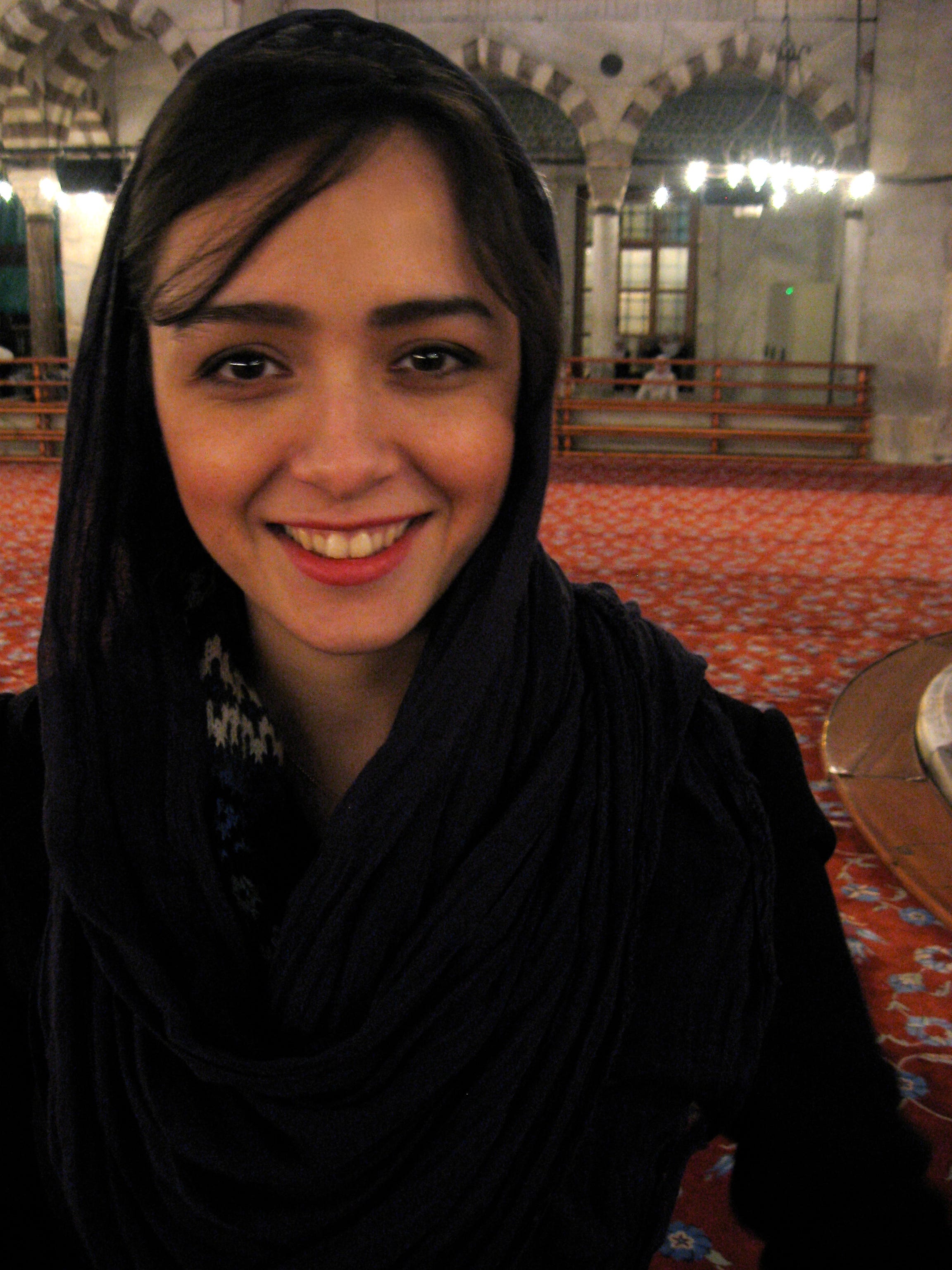
Stark’s closest Iranian cousins—hailing from the glaciated Caspian coast of Mazandaran or the Silk Road hub of Mashhad—would display a strikingly similar high-steppe countenance: tall stature, light-flecked hazel eyes, like Stark has, or brown eyes, and strong, balanced facial structures. An Iranian woman who perfectly embodies the phenotypic archetype of his closest distant cousins from the northern Caspian or northeastern Silk Road regions is the acclaimed Iranian actress Taraneh Alidoosti. Stark’s closest Persian cousins would resemble neither the impoverished, backward, religious populations of Iran’s southern deserts nor the ostentatiously wealthy, Persian-Mizrahi Shahs of Sunset caricatures of Beverly Hills. Physically, they would reject both phenotypic extremes—lacking the deep, UV-saturated olive complexions, heavy makeup, and prominent aquiline profiles of the reality television elite, as well as the severe, sun-worn features characteristic of the rural south. Instead, they would present a soft, elegant West-Eurasian countenance defined by fair skin, straight or gently refined nasal contours, and expressive hazel or light-brown eyes that align with the Euro-Siberian continuum.
Darband, Tehran

Culturally and intellectually, they would find both extremes profoundly alienating. They would fiercely reject the austere, life-denying puritanism of Islamic attire and theocratically enforced modesty, viewing it as a suffocating assault on human form and intellect. Yet, they would feel an equal contempt for the hollow, hyper-financialized materialism of Rodeo Drive and the gold-plated, conspicuous consumerism of Beverly Hills mansions, which they would view as a sterile distortion of true status. Instead, they would find far more profound beauty in the terraced, mountain-carved gardens of Darband in northern Tehran, where classical Persian poetry, wine, and an aristocratic reverence for nature and art form a quiet, secular sanctuary. They would walk through those emerald mountain valleys seeking intellectual refinement and aesthetic form, viewing both the religious dark ages of the south and the flashy commercialism of Southern California as twin cultural deserts that they—and Stark—instinctively transcend.
Tehrangeles (Westwood)

Socioeconomically, both factions belong to the educated, urban avant-garde of their respective nations; Stark’s Israeli cousins exist as the secular, tech-driven, and institutional intelligentsia of coastal Tel Aviv, while his Iranian cousins comprise the affluent, fiercely secular, and Western-looking elite of northern Tehran, operating in high-status academic and creative spheres. Crucially, these two cousins find their ultimate structural connection in two distinct historical nodes: a 19th Century common Jewish ancestor in the Pale of Settlement or West Prussia that binds Stark to the Israeli cousin, and a deep, pre-historic common ancestor in the 5,000-year-old Yamnaya culture of the Eurasian Steppe that binds him to his much more distant Iranian cousin. By placing a cosmopolitan White “Amerimutt” Californian at the center of this ancestral triangle, Starkian statecraft bridges the geographic divide, illustrating how his closest Near Eastern cousins would live identical lives of progressive rationalism, structural privilege, and cosmopolitan sophistication, completely detached from the religious fundamentalism surrounding them.
Stark’s genetic profile positions him at a unique, cross-continental intersection with the secular, intellectual elites of both the Jewish and Persian worlds. Through his Jaffe-Hirsch lineage, he carries an unbroken biological link to a legendary European rabbinical dynasty, while his dominant Northwest European and West Slavic core matches the ancient Yamnaya Steppe DNA found at its highest Near Eastern levels among secular Iranians of the northern Caspian and Silk Road regions. This deep-ancestry blueprint aligns Stark perfectly with a sort of secular “Brahmin” class—the tech-driven, avant-garde creators of coastal Tel Aviv and the cosmopolitan intelligentsia of northern Tehran—who prioritize subtle aesthetics, intellect, and artistic form over theocratic zealotry or loud consumerism. Consequently, both Stark and these elite factions experience an identical alienation from modern tribal groupthink and flashy commercial cultures; his instinctual rejection of that hyper-financialized lifestyle was routinely mislabeled as anti-semitism or anti-Persian by a superficial nouveau riche Los Angeles diaspora culture that, out of sheer ignorance, routinely confuses a profound distaste for crass new-money materialism with ancestral prejudice.
Israeli Kibbutz in Kfar Masaryk
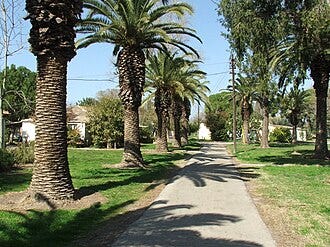
The Starkian blueprint is completely incompatible with both the puritanical, life-denying dogmatism of religious fundamentalists—such as the Iranian clerical establishment or Israel's ultra-Orthodox Haredim—and the hollow, hyper-financialized consumerism of modern metropolitan hubs. Instead, it finds its ultimate civilizational compatibility in two seemingly disparate, yet genetically linked, romantic movements: the historic Kibbutz movement of early secular Israel and the ancient, aristocratic Persian culture of poetry, wine, and beauty worship championed by the classical elites of Khorasan. The early socialist Kibbutzim, pioneered by Litvak and Central European thinkers, represented an aesthetic of agrarian romanticism, communal synthesis, and high intellectualism stripped of religious mysticism. This exact same high-culture ethos animates the classical Persian soul, which for centuries used the transcendent poetry of Hafiz and Rumi to rebel against Islamic fundamentalism, elevating aesthetic beauty and spiritual refinement to the status of a religion.
In the Starkian framework, the early Israeli pioneer tilling the soil of Galilee and the Sufi mystic composing verses in the orchards of Nishapur are cultural twins born of the same deep West-Eurasian ancestral continuum. By building its alliance system around these specific factions—the secular, poetry-worshipping Persian gentiles and the cultural, institutional descendants of the Kibbutz founders—Starkian statecraft actively wages war against both theocratic dark ages and modern materialistic decay, resurrecting a lost Near Eastern aristocracy of beauty, intellect, and form.
In the hyper-concentrated laboratory of the California diaspora—the Starkian profile's home ground—this genomic calculus manifests as a highly volatile matrix of local alliances and social frictions. Walking through the cultural enclaves of Los Angeles and the Bay Area, the Starkian finds an immediate, organic synergy with the highly educated, secular Persian gentiles of the Iranian diaspora, whose Silk Road ancestry and Western-looking cosmopolitanism mirror their own deep Eurasian markers. This natural camaraderie creates a powerful localized front when paired with secular German Jews (Yekkes) and Litvak descendants, uniting California’s intellectual and tech-driven hubs along a shared, rationalist civilizational axis. However, this blueprint simultaneously sparks immense friction with two of the state's most powerful immigrant enclaves: the tightly knit Persian Jewish community of "Tehrangeles" and the ultra-Orthodox Ashkenazi sectors. Because Persian Jews possess an ancient Near Eastern genome completely isolated from the Western steppe, and because Orthodox theological dogmatism directly opposes the secular Enlightenment values of the Jaffe-Haskalah line, the Starkian framework rejects them as geopolitical partners. The result is a total reorganization of California’s diaspora politics, forging a brand-new, secular Euro-Iranian-Ashkenazi alliance that leaves religious traditionalists and isolated regional enclaves on the outside looking in.
Under a Starkian framework, the secular, steppe-descended factions of northern and northeastern Iran and the cultural descendants of Israel’s early Labor Zionist Kibbutz movement emerge as natural, organic geopolitical allies. In a rational world unburdened by theological delusions, these two groups would form the bedrock of a dominant Near Eastern security architecture. Their mutual affinity is structurally suppressed only by the artificial supremacy of the foreign elements currently ruling their respective states: the strictly Near Eastern, Mesopotamian-shifted Islamic regime in Tehran, and the populist, Mizrahi-dominated religious right wing in Jerusalem. Were it not for the ongoing, exhausting conflict engineered by these genetically distant governing factions, the secular Euro-Iranian-Ashkenazi alliance would effortlessly co-opt regional trade and military intelligence, operating on a shared baseline of technocratic realism and high-culture intellectualism.
If Iran and Israel represent regions of unexpected proximity, the Sunni Arab world—specifically the Gulf Cooperating Council (GCC) states—represents a zone of maximum genetic distance. Traditional Western diplomacy treats Saudi Arabia, the UAE, and Qatar as bedrock security partners. Starkian geopolitics completely flips this leverage. The indigenous populations of the Arabian Peninsula possess a highly isolated Southwest Asian/Natufian core with virtually zero Yamnaya Steppe, West Slavic, or North Sea alleles. Mathematically, they represent the absolute furthest point from the Starkian genome in the entire EMEA (Europe, Middle East, Africa) theater.
This structural distance must be reconciled with a fascinating piece of genealogical lore: the speculation of highly dubious descent from the Prophet Muhammad. European royal genealogy widely notes that Queen Victoria (and by extension, the broader British and European aristocratic networks are allegedly descended from Zaida of Seville, a 11th-century Muslim princess who fled to the Christian court of Castile and claimed descent from the Kings of Seville, who traced their line directly to the Prophet’s daughter, Fatimah.
Zaida of Seville
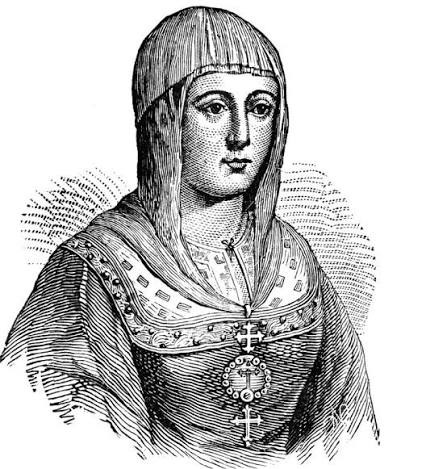
If Stark’s findings from online research from a distant British colonial ancestor are true, it would mean that a microscopic, statistically unmeasurable genealogical thread links the Starkian profile to the Hashemite lineage of Western Arabia. However, Starkian geopolitics is cold and empirical; it prioritizes genomic distance over legendary pedigree. Even if a single segment of DNA from 7th-century Mecca survived the journey through Spanish royalty into the British Isles, it is completely overwhelmed by waves of Viking, Anglo-Saxon, Celtic, and Polish migrations. In the Starkian calculations, the Gulf Arab states remain an abstract, distant sphere with which alliances can only ever be transactional, never intrinsic.
The primary strategic objective of this hypothetical axis would be the total containment and isolation of the Sunni Gulf Arab sphere. For centuries, the non-Arab populations of the Near East have faced demographic and economic pressures from the Arabian Peninsula. By linking a secular Tel Aviv directly to a liberated, Silk Road-oriented Mashhad, Starkian geopolitics creates a northern non-Arab pincer capable of checking the hyper-financialized expansionism of the Sunni Gulf monarchies to to Turkey’s neo-Ottoman ambitions. Rather than allowing Western strategy to be dictated by the transactional whims of Saudi Arabia or Qatar—populations that represent the absolute maximum genetic distance from the Euro-Atlantic continuum—this northern super-alliance would establish a permanent, civilizational buffer zone. By uniting the shared Yamnaya and European ancestral markers of the Levant’s and Iran’s northern frontiers, this axis would re-delegate the desert kingdoms of the Gulf to the deep geographic isolation their population structure demands, permanently tilting the balance of power back toward the Euro-Siberian continuum. The Sunni Arab world is treated as an island of geographic isolation, completely distinct from the Euro-Siberian and North Sea genetic continuum.
By synthesizing these components, Starkian Geopolitics transcends the regional squabbles of the Levant to build a breathtaking, macro-regional alliance system. It is a grand strategy that seamlessly links America, Europe, and the Middle East not by ideological treatises, but by the deep, unwritten laws of human population structure.
This super-axis establishes a clear hierarchy of geopolitical affinity:
The Euro-Atlantic Core: The United States, Great Britain, Germany, and Scandinavia form the unshakeable cultural and genetic foundation of this world order.
The Central-Eastern European Bridge: Poland acts as the critical West Slavic anchor, bridging the West to the East, matching a quarter of my genome.
The Near Eastern Outposts: Inside the Middle East, the axis bypasses the entire Sunni Arab world, focusing its energy exclusively on a Secular, Labor-Leaning Israel (the Jaffe/Hirsch legacy) and a Future, Liberated, Northern/Northeast Iran (the Yamnaya/Rumi legacy).
Translating the Starkian doctrine from a theoretical blueprint into a functional statecraft requires identifying which modern Western politicians would naturally champion or fiercely resist its parameters. The natural allies of Starkian geopolitics are found among tech-technocratic pragmatists, secular classical liberals, and traditional Euro-Atlantic defense hawks who favor cold, data-driven realpolitik over ideological crusades. Politicians who lean into secular institutionalism, intelligence-driven statecraft, and a strict alignment with the traditional Western core—such as centrist technocrats, intelligence-community veterans, or defense-oriented pragmatists within the Euro-Atlantic sphere—would likely embrace its focus on empirical, structural stability.
The true radicalism of Starkian geopolitics lies in its power to systematically invert the modern diplomatic chessboard, creating a surreal landscape where historic adversaries are united by genetic affinity and trusted allies are severed by genomic distance. By replacing volatile ideological loyalty with immutable population data, the Starkian framework completely undermines traditional treaty networks. While modern Washington and Jerusalem view the Sunni Gulf monarchies as foundational security partners against a hostile Iranian regime, as part of the Abraham Accords, a Starkian analysis exposes the Arab states of the Gulf as the ultimate genomic outliers—possessing maximum genetic distance from the Euro-Atlantic core. Conversely, the model reveals that a Westerner shares a deep, prehistoric ancestral bridge with the very population currently chanting against the West: the people of Northeast Iran. By exposing these hidden biological alignments, Starkian statecraft creates a world where a secular Westerner shares more common ground with a Persian from Mashhad than with an Israeli politician like Itamar Ben-Gvir or a Saudi prince, turning the traditional map of Middle Eastern alliances upside down.
Conversely, the doctrine would face visceral, absolute opposition from two distinct political factions. On the Right, populist nationalists, Christian Zionists, and hardline religious conservatives would fiercely reject its complete dismissal of theological ties to the Holy Land and its abandonment of traditional partnerships like the U.S.–Saudi alliance. On the Left, progressive humanists and anti-colonial internationalists would vehemently oppose the Starkian model, condemning its explicit genetic framework as an unacceptable form of biological determinism and neo-imperialism. By exposing these fault lines, the Starkian blueprint draws a clear boundary in Western governance, offering a specialized weapon for technocratic realists while presenting an existential threat to ideological and theological purists alike.
For liberal, intersectional Pro-Palestine leftists, the doctrine is an absolute moral nightmare; it explicitly confirms their historical narrative that early Zionism was engineered by a European-shifted demographic, yet instead of weaponizing this to critique the state, the Starkian framework celebrates this Euro-Slavic data to assert an organic, high-culture civilizational right to rule. Simultaneously, the framework induces a severe existential crisis for traditional Neoconservatives and mainstream defense institutions like AIPAC and the Anti-Defamation League (ADL). While they are instinctively enticed by a data-driven strategy designed to ruthlessly dismantle the Islamic Republic of Iran, they are left structurally panicked by the doctrine’s absolute disloyalty to standard establishment pillars—specifically its demands to abandon the Saudi security architecture, excommunicate Israel’s modern right-wing populist governing coalition, and replace ecumenical, values-based lobbying with cold population genomics.
This panic is fiercely shared by the Gulf Arab elites themselves, who find their immensely wealthy and strategically vital nations unceremoniously relegated to “structural outliers” and “civilizational walls” to be transactionally discarded based on their Southwest Asian genomic isolation. Most ironically, the blueprint completely shatters the fragile taxonomy of the antisemitic, white-nationalist Right. By elevating the historic migration of the ancient “Aryan” Yamnaya Steppe pastoralists—the ultimate prize of white supremacist mythology—the Starkian model forces them to confront a cold, mathematical reality: on a global PCA distance plot, the pure genomic ghost of those ancient Eurasian horsemen pulls a Northwest European closer to a Muslim gentile from Northeast Iran than to many Mediterranean populations, while their obsessive racial categories are completely scrambled by the Starkian profile’s integrated, elite Ashkenazi Rabbinical lineage. By offending all these factions simultaneously, Starkian statecraft achieves a brilliant, absurdist irony, transforming the unyielding data of human chromosomes into a multi-directional weapon that unites bitter, mortal political enemies in a shared, helpless consensus of ideological disgust.
The ultimate comedic and philosophical triumph of Starkian geopolitics is its unique capacity to scramble the global political compass, inciting a unified front of visceral outrage across seemingly irreconcilable factions. The ultimate ideological absurdity of the Starkian Blueprint is that it forces liberal Pro-Palestine leftists, Nick Fuentes, establishment Neoconservatives, institutional Jewish organizations like AIPAC and the Anti-Defamation League, Gulf Arab monarchies, the theocratic mullahs of Tehran, and the flashy cast of Shahs of Sunset into a hilariously ironic coalition of shared outrage, proving that nothing unites an antisemitic white supremacist, a mainstream Jewish defense organization, an Islamic regime, and a Beverly Hills reality television elite faster than a genomic data sheet that systematically dismantles all of their respective worldviews.
The natural champions of this doctrine are found within the secular, pre-revolutionary Iranian exile diaspora—the high-society Persian enclaves of Los Angeles, London, and Paris—who have spent decades feeling deeply alienated by Islamic fundamentalism and would feel deeply validated by an ideology that exalts their classical, pre-Islamic heritage of poetry, wine, and Silk Road cosmopolitanism over Arab-centric geopolitics. Joining them in an unexpected coalition would be the global community of genetic genealogists, hyper-rationalist technocrats, and data-driven corporate strategists. These groups would enthusiastically embrace the framework for its cold, refreshing dismissal of human sentimentality, treating the Starkian model as the ultimate manifestation of absolute empirical pragmatism—a world where messy geopolitical conflicts are cleanly resolved by automated, immutable genomic calculations rather than volatile human emotions. By uniting elite secular exiles with tech-vanguard realists, the Starkian doctrine constructs an unconventional, highly sophisticated intellectual coalition capable of operating entirely outside the boundaries of conventional Western political thought.
By anchoring its framework in unyielding population structure, Starkian geopolitics completely reconciles the historic, bitter split between Third Worldist anti-imperialism and Neoconservative interventionism, forcing a radical realignment of Western grand strategy. Third Worldism has long critiqued the West for imposing artificial colonial borders and superficial democratic values on deeply complex, organic regional populations. Neoconservatism, meanwhile, has championed aggressive, values-driven intervention to remake the Middle East in the West’s ideological image. The Starkian doctrine satisfies both camps while discarding their failures: it validates the Third Worldist critique by agreeing that modern nation-states like Iraq, Syria, or a monolithic Iran are artificial, volatile fabrications that ignore organic human realities. Yet, it simultaneously equips the Neoconservative impulse with a far more precise, biologically grounded lens for intervention. Instead of waging endless wars to build Western institutions where there is no genetic or cultural affinity, the Starkian framework identifies exact, pre-existing population clusters—such as the secular, Silk Road-descended elites of Northern Iran or the historical Labor Zionist core of Israel—and forms organic, deep-ancestry alliances with them. This shatters the traditional Left-Right foreign policy gridlock, replacing sentimental nation-building with a cold, data-driven strategy of selective civilizational alignment.
Ultimately, the evolution of Stark’s geopolitical worldview mirrors a profound psychological journey—one where the raw alienation of Stark’s youth growing up in LA was gradually channeled through competing ideological lenses before finally crystallizing into a mature, data-driven realpolitik. In his early phases, the visceral rejection he felt toward the flashy, new-money materialism of LA’s landscape naturally pushed him toward the fierce, anti-imperialist rhetoric of Anti-Zionist Third Worldism, including protesting against AIPAC. This ideology provided a clinical language to dissect and critique what he perceived as the artificial, commercial fabrications of modern colonial borders and Western consumer expansionism that produced the alienation and atomization that he experienced growing up.
Yet, as he witnessed the chaotic, anti-Western and anti-White currents of the Left, he swung toward a rigid, civilizational Western Chauvinism, seeking safety and order in the dominance of the Euro-American Atlantic core. It was only by looking past these ideological extremes and immersing himself in the cold, unyielding data of genetics and genealogy that he discovered the structural key to his identity. Unlocking the empirical reality of his chromosomes—the precise, multi-layered synthesis of his Northwest European core foundation, his West Slavic quarter, and legendary Jaffe-Hirsch rabbinical lineage—allowed him to discard the blunt, superficial weapons of both the Left and the Right. By replacing volatile political dogmas with the timeless laws of population genomics, he realized that his true allegiance belongs neither to artificial nation-states nor to hollow consumer empires. Instead, this scientific awakening anchored him in a deeply mature, aristocratic civilizational framework: an elite, transcendent alliance of intellect, form, and deep ancestry that unites him with the secular avant-garde of the Near East, permanently insulating him from the cultural deserts of modern tribal groupthink.
Philosophically, the Starkian doctrine occupies a highly specific intersection of Scientific Euro-Atlanticism, Secular Vanguardism, and High Biopolitics. It completely bypasses the traditional left-right political spectrum, rejecting both the moralistic rhetoric of liberal internationalism and the theological, blood-and-soil mysticism of religious nationalism. Instead, it operates on a framework of strict genetic determinism, treating human chromosomes as an unyielding, mathematical blueprint for natural geopolitical compatibility. By framing the core of global stability around a highly westernized, Anglo-Germanic, and West Slavic axis, it functions as a form of technocratic civilizationalism. In this system, statecraft is stripped of sentimental treaties and ideological whims, replaced instead by the cold, empirical data of deep ancestry and population structure.
At its deepest metaphysical level, Starkian geopolitics transcends cold statistical plots to resolve the cultural war raging across the Near East, mapping perfectly onto the bitter trichotomy dividing religious fundamentalism, sterile Western consumer materialism, and an idealized, aristocratic culture of poetry, beauty worship, and communal idealism. Human population structure does not merely dictate allele frequencies; it shapes the aesthetic and philosophical expressions of a civilization.
The Starkian Blueprint proves that our current political alignments are merely temporary illusions. By looking past the headlines and peering into our own chromosomes, we discover a deeper, more permanent map—one that connects an American citizen of Anglo-Germanic and Polish descent to the valleys of Lithuania, the shores of the Baltic, the founders of Tel Aviv, and the ancient, nomadic horsemen who left their enduring mark on both the fjords of Norway and the high plains of Northeast Iran.
What to say? Certainly, one of the longest self-indulging posts to have ever appeared on substack
I'm not reading all of that
I'm happy for you tho
Or sad that happened
Also, I mean... I sympathise, but the pan-aryan global aristocracy doesn't seem to be in the cards for the near future. Probably have to go through another few electoral cycles of anti-globalists banging their heads against a wall