
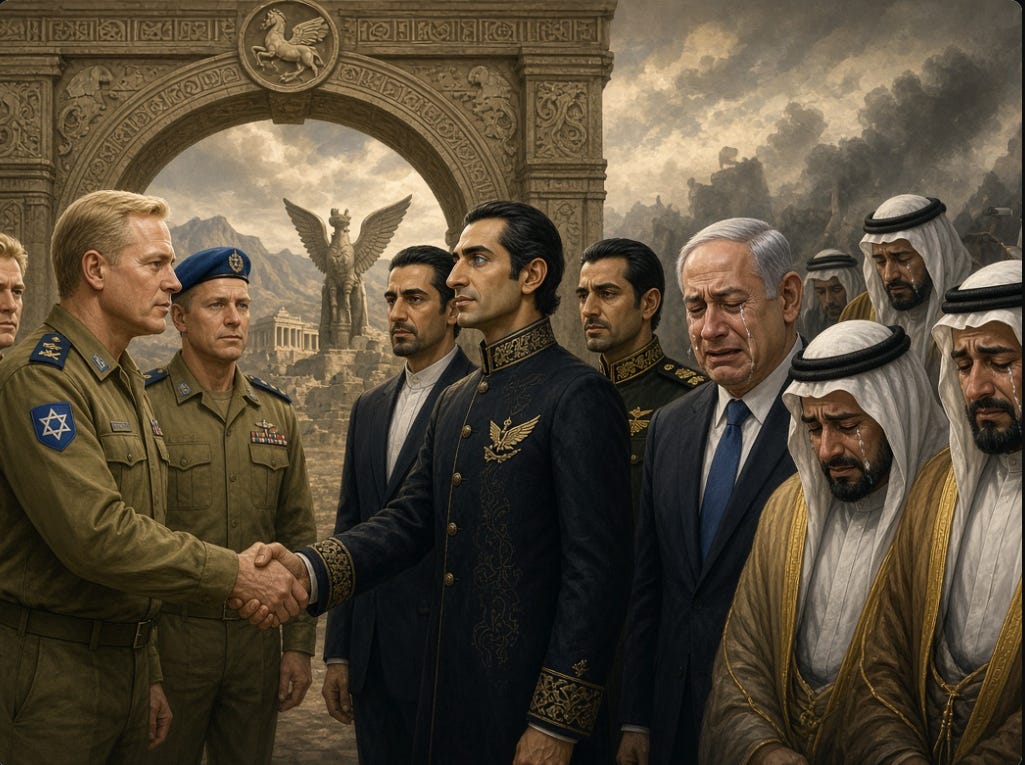
The Starkian Geopolitical Blueprint discards twentieth-century orthodoxies—colonial borders, the Arab-Israeli axis, the Riyadh-Tehran cold war—and replaced them with the cold arithmetic of genetic distance measured against a specific genomic profile: Stark’s overwhelmingly Northwest European (Danish, Norwegian, German, English, Welsh, Irish, Scots-Irish), anchored by a substantial West Slavic Polish component, sharpened by a precise 1/16th Ashkenazi line hailing from Mogilev, Belarus and West Prussia. That profile’s high Yamnaya Steppe and Ancient North Eurasian signal, combined with the Litvak-Yekke elite vector, produced an inverted map: closer affinity to certain Northeast Iranian and Caspian populations and a decisive preference for Israel’s historical secular Labor Zionist core over Israel’s contemporary right-wing populist and Mizrahi factions.
What follows is the logical next chapter: how that blueprint, once activated as living geopolitics, reorders the region through successive shocks, internal fractures, elite realignments, and cascading external effects. It is not prediction of inevitable destiny but a stress-test of genetic-proximity logic itself.
This geopolitical realignment begins with Iran sublimating the Gulf’s core materialist and religiously rigid polities—Saudi Arabia, the UAE, Qatar, and Bahrain—whose populations sit farther from the Starkian coordinates. These societies, shaped by Arabian Peninsula Bedouin and coastal trading ancestries with limited Steppe admixture relative to northern Iranian groups, and organized around petro-wealth consumerism or Wahhabi-derived orthodoxy, register as civilizationally distant. Starkian statecraft would therefore treat them as structural adversaries rather than temporary tactical partners. Instruments would be asymmetric and deniable: intensified proxy pressure via residual Shia networks in the Eastern Province and Bahrain, cyber and economic disruption of hydrocarbon logistics, and narrative warfare that frames Gulf elites as rootless rentiers alienated from deeper Eurasian Indo-Iranian currents. The goal is not immediate conquest but sustained weakening—eroding the Gulf’s capacity to underwrite anti-Iranian coalitions while highlighting the genetic and cultural gap.
Victory against Gulf pressure, or the shock of heavy U.S. retaliation against Iran, would accelerate Iran’s internal genetic sorting. Northern and northeastern clusters—Mazandarani, Gilaki, Khorasani, and Azerbaijani-influenced groups carrying higher Steppe and West Eurasian hunter-gatherer components—gain leverage. These populations plot closer to the Starkian profile than the central-southern plateau core. Secular technocrats, Caspian-linked military officers, and certain Silk Road merchant-intellectual networks would marginalize factions whose genomes and cultural styles are more purely Near Eastern and Mesopotamian-shifted.
The irony is sharp: elements of the existing regime and religious elite who themselves carry northern or Khorasani ancestry (figures whose regional origins track closer to the Yamnaya signal) could be absorbed or elevated within a reformed power structure, while more southern or central clerical networks are sidelined. The result is not wholesale regime collapse into liberal democracy nor a partition of the country but rather a selective aristocratic consolidation: authority concentrates among those whose deep ancestry and cultural orientation—poetry, philosophical abstraction, high-modernist aesthetics—resonate with the Starkian preference for secular vanguardism over both theocratic rigidity and pure consumer materialism.
The emergent Iranian elite would cultivate an explicitly aristocratic register. Governance prioritizes competence, aesthetic refinement, and long-horizon civilizational projects over populist mobilization or clerical veto. Cultural policy elevates the Indo-Iranian classical tradition (Rumi’s Khorasani lineage as civilizational touchstone), modern science, and a restrained secularism that tolerates private piety while stripping public life of both fundamentalist enforcement and Gulf-style ostentation. Political institutions tilt toward meritocratic, albeit aristocratic, councils weighted by regional representation from high-Steppe provinces, with limited mass electoral volatility. The tone is high-biopolitical and technocratic rather than egalitarian or theocratic—an Indo-Iranian analogue to the secular Euro-Atlantic vanguard the original Blueprint favored.
The Starkian Blueprint: Redefining Middle East Geopolitics Through the Prism of Genetic Distance

Robert Stark as Geopolitical Kingmaker among the Zio-Elites of Beverly Hills
This internal shift fractures Iran’s traditional external partners. Southern Iranian Gulf communities and Arab Shia populations in Iraq, Lebanon, and the Gulf states—genetically more distant from the Starkian profile and culturally oriented toward Arab or Mesopotamian frames—lose privileged status. Proxy networks that relied on religious solidarity rather than ancestral affinity weaken. The new elite recalibrates: less pan-Shia internationalism, more selective engagement with groups and states whose population structure or elite culture shows greater Eurasian Steppe continuity. Residual influence in the Levant becomes transactional rather than ideological; southern Iranian commercial diasporas face relative marginalization inside the reformed state.
Arab Shia populations—whether in southern Iraq, Lebanon’s Shia communities, Bahrain, or the residual networks of the Gulf’s Eastern Province—remain markedly more distant from the Starkian genomic coordinates than the northern Iranian or secular Ashkenazi elites, their deeper Southwest Asian and Mesopotamian profiles lacking the elevated Yamnaya and Northwest-European signals that define the new order. Yet precisely because of this distance they can crystallize into an autonomous geopolitical bloc of their own, one that neither seeks absorption into the Starkian order nor submits to it. Their shared interest in containing the materialist, religiously rigid Sunni Gulf monarchies supplies the pragmatic glue: both the reformed northern-Iranian aristocracy and the post-Netanyahu Israeli elite recognize the Gulf as a common structural adversary, while the Arab Shia blocs understand that the Starkian powers, though genetically remote, will not actively dismantle them so long as they neutralize Riyadh and Abu Dhabi. The resulting arrangement is one of cool, non-egalitarian coexistence rather than alliance or enmity; by channeling Arab Shia energies southward against the Gulf, the new configuration removes the principal vector of proxy confrontation that once inflamed the Levant, thereby lowering the temperature between the genetically closer Israeli regime and the more distant Arab Shia formations that leads to a detente between Israel and Hezbollah.
Southern Europeans plot genetically closer to western Turkish and Lebanese Christian populations than the full Starkian profile (northern European + Polish + specific Ashkenazi) does. Starkian distance to Anatolian and Levantine Christian clusters is therefore greater than to certain northern Iranian groups, yet still smaller than to core Arabian or deep southern Iranian isolates. Realignments follow: Turkey experiences elite competition between more European-leaning coastal and urban networks and inland Anatolian majorities; pragmatic secular or post-Kemalist factions gain relative advantage in any Starkian-influenced order. In Syria and Lebanon, residual Christian and certain urban Alawite or mixed communities become points of selective engagement, while broader Sunni Arab majorities remain more distant. The Levant fragments further along ancestral rather than purely confessional lines, with external powers adjusting patronage accordingly.
Parallel pressure produces regime change in Israel. The Netanyahu-era coalition, heavily weighted toward Mizrahi, religious-nationalist, and newer immigrant factions whose genetic distance from the Starkian Litvak-Yekke core is greater, loses coherence. A successor constellation draws more heavily from the historical secular Ashkenazi elite—descendants of the Mogilev-borderland and Central European networks that produced the early Labor and cultural establishment. Certain niche Orthodox factions tracing Litvak or related lines (including possible residual Mogilev connections) could find limited overlap, but the dominant tone shifts away from populist religious nationalism.
This realignment could also include the niche among Israel’s Right, that is friendlier to Europe but deeply skeptical of the Arab Gulf states, which is represented by the secular, hawkish, right-wing nationalist immigrant faction, historically embodied by Avigdor Lieberman’s Yisrael Beytenu party. This faction promotes a Eurocentric, Western-nationalist alignment and has previously advocated for Israel to join the European Union, while fiercely opposing the influence of Arab Gulf states or reliance on Middle Eastern regional dynamics. Genetically, this specific group—composed heavily of Ashkenazi Jews originating from the former Russian Empire and Central/Eastern Europe—is significantly closer to Stark’s Jewish ancestry than Likud whose power structure has shifted dramatically toward a coalition driven by Sephardic, Mizrahi (Middle Eastern/North African), and national-religious factions.
Stark’s Israeli cousins who share this distinct Litvak and Yekke lineage carry a cultural and intellectual DNA that naturally inclines them to be much more pro-European and highly skeptical of the Arab Gulf states compared to the average Israeli. Because they inherit the foundational values of Yekkishkeit—which prizes strict rule of law, institutional transparency, and Western civic order—along with the hyper-rational, analytical skepticism of the Litvak tradition, they are wired to view international relations through a lens of formal treaties and shared democratic principles rather than shifting transactional alliances. Stark’s Israeli cousins’ affinity for Europe despite its agonizing history of antisemitism is rooted in the distinct Yekke and Litvak understanding that the tragedy of the Holocaust was a catastrophic betrayal of Western civilization, not a reflection of its core ideals. Guided by the intellectual legacy of the Enlightenment and the legalistic structure of Yekkishkeit, they view European values—democracy, the universal rule of law, scientific rationalism, and institutional transparency—as the highest achievements of human governance, principles that their own ancestors crucially helped shape and cultivate. For them, abandoning Europe because of its past would mean letting tyranny win; instead, they see modern Israel’s mission as being the ultimate, hyper-advanced outpost of those exact Western values in the Middle East. This is precisely why Europeans and Euro-Americans should look past Israel's loud, populist ruling coalition and form a deep, deliberate alliance with this specific secular, institutionalist demographic.
For them, Europe is not just a trading partner or a vacation destination; it is Israel’s spiritual, legal, and cultural anchor, representing a Western civilization they believe Israel must mirror and protect. Consequently, while a broader Israeli populace influenced by Likud’s populism might enthusiastically celebrate the financial and military glitz of the Abraham Accords, Stark’s Israeli cousins likely view deep reliance on the undemocratic, dynastic monarchies of the Gulf with profound unease. They are more likely to see these partnerships as unstable, short-term security arrangements that lack a foundation of shared values, worrying that tying Israel’s geopolitical future to Middle Eastern autocracies pulls the country away from its Western democratic heritage and deeper into a volatile regional dynamic.
Galitzianer Israelis, who trace their ancestry to Galicia, a historic and culturally distinct region that spanned southeastern Poland and western Ukraine and Mizrahi Israelis would arrive at a shared hawkishness through two entirely different geopolitical and cultural pathways. Mizrahi Israelis, rooted in Middle Eastern and North African heritage, approach regional dynamics through a lens of local survival and cultural realism; they enthusiastically back the transactional “Peace through Strength” model with the Gulf states because they view the Middle East as a zero-sum neighborhood where fluid, strongman alliances are far more reliable than Western lectures. Galitzianers, carrying the historical memory of the chaotic, shifting borderlands of Eastern Europe, operate on a deeply ingrained, insular survival instinct; they view international law and borders as inherently fluid and malleable, making them perfectly comfortable with Likud’s opportunistic backroom deals with absolute monarchs.
When it comes to Europe, Mizrahis harbor a deep resentment toward Western European criticism, viewing it as a detached, neo-colonial continuation of the same condescending attitudes the old Ashkenazi elite held toward Middle Eastern culture. Galitzianers view Europe with a profound, historical trauma rooted in centuries of intense persecution and traditionalist segregation, seeing an unbroken line from the pogroms of old Europe to modern EU critiques. Consequently, both groups reject the orderly, Eurocentric universalism of the Litvak-Yekke establishment, uniting in a populist, Middle Eastern-anchored foreign policy that enthusiastically pivots toward wealthy Gulf autocrats while treating Western Europe as an inherently biased, historical adversary.
Stark’s Israeli cousins’ friendlier stance to Europe amid intense geopolitical friction—reconciles perfectly with the harsh, urgent tone of his article on the Spain vs. Morocco Ceuta conflict that called the Israeli regime an enemy of the West. In Stark’s piece, he rightly expose how Likud’s exploitation of the Abraham Accords to back Morocco’s aggression acts as an opportunistic betrayal of the West, highlighting a toxic strain of political revenge within Israel’s current populist ruling coalition. His cousins would not only agree with that anger; they would view that very same behavior from the Israeli right as a deeply embarrassing, short-sighted desecration of Israel’s civilizational roots. Because his Litvak-Yekke DNA wires them to value structured European legalism over fluid, autocratic Middle Eastern alignments, they view the weaponization of migration against a democratic European state like Spain as completely illegitimate. By validating the harsh realities Stark calls out—where right-wing Zionists and neocons openly mock European sovereignty—his cousins represent the exact domestic counterweight needed to break this dangerous alignment. They validate his alarm by proving that the old, rational, Eurocentric Israel recognizes that throwing Europe under the bus is a strategic and moral catastrophe.
Stark’s article on Ceuta would draw a sharp line through the Israeli political psyche, eliciting visceral hatred from the ruling populist coalition and profound appreciation from the marginalized secular establishment. On one side, the Mizrahi and national-religious Likud base, alongside the messianic factions surrounding figures like Itamar Ben-Gvir, would absolutely loathe the piece. They would view the defense of Spain’s sovereignty over Ceuta as elitist, out-of-touch Europhilia, fiercely lashing out against his critique of their "peace through strength" Abraham Accords model. Operating on a zero-sum, street-fight doctrine of geopolitics, these right-wing populists would brand Stark a condescending Westerner who values European borders over Israeli defensive interests. Conversely, Stark’s secular Litvak-Yekke cousins and the broader institutionalist center-left might deeply appreciate his writing, reading it with a grim sense of validation. Traumatized by how the Netanyahu regime has systematically isolated Israel from its European civilizational roots, this secular elite would find the hyper-rational, rule-of-law framework incredibly refreshing. They would applaud him exposing the strategic madness of the ruling coalition, agreeing entirely that cheering on a Moroccan hybrid warfare migration surge against a Western democracy is both a moral catastrophe and geopolitical suicide.
A hypothetical Israeli political realignment structured purely around genetic proximity to Stark’s German “Yekke” and Litvak Jewish ancestry—combined with a strict pro-Europe, anti-Gulf Arab foreign policy, would trigger a foundational fracturing of Israel’s traditional right-left divide. Domestically, such a faction would have to consciously decouple itself from the modern, Middle Eastern-integrated Israeli mainstream, positioning itself as a fiercely secular, Eurocentric vanguard. By rejecting the Mizrahi-dominated, populist traditionalism of Likud and the religious right, this hypothetical movement would explicitly prioritize the cultural and genetic legacy of the old Ashkenazi Pale of Settlement as the true civilizational anchor of the state.
In foreign affairs, this realignment would completely abandon Benjamin Netanyahu’s signature “Abraham Accords” doctrine, viewing financial and diplomatic reliance on the oil-rich Gulf monarchies not as a strategic triumph, but as a dangerous dilution of Israel’s Western sovereignty and a capitulation to Islamic influence. Instead, this faction would aggressively pivot toward Europe—including the nationalist and secularist corridors of Central and Eastern Europe—offering Israel as a hyper-technological, ideologically aligned outpost of Western civilization.
Policy toward the Palestinians abandons both liberal egalitarian frameworks and the harsher crueler edges associated with the prior right-wing administration. It is hierarchical and realist: security red lines remain firm, demographic and cultural distance is acknowledged without romanticization, and governance arrangements favor functional separation and economic incentives over either one-state fantasies or permanent low-intensity domination. The posture is aristocratic restraint rather than populist vengeance or universalist guilt—managing proximity without pretending genetic or civilizational equivalence.
Under the Starkian realignment the Palestinian question is resolved neither through liberal-egalitarian frameworks that erase genetic and civilizational distance nor through the maximalist, low-restraint methods associated with the Netanyahu era. Instead a hierarchical yet non-vindictive settlement emerges: firm security perimeters, managed demographic separation, and calibrated economic incentives that acknowledge deep ancestral divergence without descending into collective punishment or permanent subjugation. This posture is fully compatible with the aristocratic Mogilev continuum embodied by Yitzhak Rabin, whose own Litvak lineage placed him at the genetic and cultural apex of the secular founding elite that aligns with’s Stark’s Jewish ancestry. Had Rabin lived to witness the later Gaza campaigns, he would almost certainly have regarded Netanyahu’s approach as a vulgar departure from the disciplined, state-centric realism of classic Labor Zionism—excessively populist, insufficiently attentive to long-term civilizational costs, and corrosive of the restrained aristocratic ethos that once guided Israel’s original Euro-Ashkenazi vanguard. The new order therefore recovers something closer to Rabin’s instinct: cold-eyed management of proximity rather than either sentimental equality or theatrical cruelty.
Stark’s secular Litvak-Yekke Israeli cousins would absolutely find common ground in favoring a Three-State Solution over both a chaotic suicidal One-State Solution and the cruel, short-sighted opportunism of Likud’s current platform in the occupied territories. The Three-State Solution (often called the “Egyptian-Jordanian option”) is a hyper-rational, structurally rigid approach to the conflict. It argues that instead of creating a fragile, independent Palestinian state or forcing a bi-national One-State, which would be an absolute nightmare that would inevitably destroy Israel’s secular, democratic fabric from within, administrative and security control over Gaza should be returned to Egypt, while the populated enclaves of the West Bank are re-integrated under Jordanian sovereignty, leaving Israel as a secure, homogeneous, and orderly Western-style state without the endless subjugation of the Palestinians. The Three-State framework appeals perfectly to their shared Litvak rationalism and Yekke demand for clean legal lines.
This new Israeli political system is more aristocratic and less populist: stronger institutional weight for technocratic and cultural elites, reduced reliance on coalition arithmetic with ultra-Orthodox or far-right parties, and a governing style closer to the old Labor Zionist secularism updated for contemporary constraints. “New money” and recent immigrant networks might retain economic influence but lose disproportionate political veto. The result is a cooler, more Euro-Atlantic-facing Israel that privileges genetic and cultural continuity with both Israel’s historical founding core and genetic and cultural proximity to Europe over maximalist territorial or messianic claims.
Building directly on the Starkian Blueprint’s core premise—that durable geopolitical alignments should track deep genetic distance and ancient steppe migrations rather than colonial borders, religious slogans, or twentieth-century ideological blocs—the same framework can be projected eastward into Greater Central Asia. The Starkian genomic profile (overwhelmingly Northwest European + West Slavic/Polish, with a thin but historically elite 1/16 Ashkenazi rabbinical component) sits farther from most populations of Tajikistan, Afghanistan, and Pakistan than it does from northern Iranians or the old Labor-Zionist Litvak core. Yet the same Yamnaya/ANE steppe and Indo-Iranian signals that pull the profile toward Khorasan and Mazandaran continue, at attenuated strength, into the highlands and valleys of the Pamirs, the Hindu Kush, and parts of the Afghan north. This residual affinity supplies a rational basis for selective engagement that simultaneously checks two expansive ideological projects hostile to a Euro-Atlantic-oriented order: pan-Turkism and any revival of a Sunni caliphate spanning the region.
Tajikistan offers the clearest structural bridge. As the only Persian-speaking, Indo-Iranian majority state in post-Soviet Central Asia, its population retains elevated levels of the same steppe and West Eurasian components that distinguish Northeast Iranian gentiles from more isolated southern or Mesopotamian-shifted groups. Pamiri and other highland communities further concentrate these signals. Under a Starkian reading, Tajikistan is therefore treated not as a peripheral post-Soviet republic but as the easternmost outpost of the same Indo-Iranian continuum that links the Starkian profile to Rumi’s Khorasan and the Caspian north. Policy emphasis falls on cultural, economic, and security ties that reinforce Persianate identity against Turkic linguistic and political pressure from the north and west.
Tajiks emerge as one of the clearest residual holdouts of West Eurasian, Indo-Iranian continuity deep inside Central Asia. Their genomes retain elevated steppe (Andronovo/Yamnaya-related), Iranian Neolithic, and broader West Eurasian components that create a measurable, if attenuated, ancestral bridge to Northwest European and West Slavic profiles. This places them closer to the Starkian core than the majority of surrounding populations that have been pulled into the broader East Asian and Turkic genetic sphere. Tajiks—particularly highland and Yaghnobi groups—function as a residual Indo-Iranian genetic and cultural holdout that partially resisted full absorption by successive Turkic and Mongol expansions, preserving higher West Eurasian/steppe ancestry amid surrounding populations that shifted further eastward; this dynamic can be loosely paralleled to contemporary anxieties in Europe over neo-Ottoman Turkish influence and demographic assertiveness, or in the Anglosphere over large-scale Han Chinese immigration, insofar as both involve pressures from genetically and historically more distant expansionist spheres.
Afghanistan is approached through the same genomic filter rather than as a unitary Pashtun-dominated or Taliban-defined entity. Northern and northeastern zones—historically tied to Greater Khorasan, Balkh, and the old Silk Road—carry higher frequencies of the Indo-Iranian and steppe ancestry that create the distant but real affinity noted in the original Blueprint (including the phenotypic observation of certain Afghan refugees). These areas become the natural partners for engagement, while southern and heavily Pashtun belts that show stronger Southwest Asian or more isolated profiles are deprioritized. The practical effect is a deliberate fracture of any monolithic “Afghan” project that would otherwise serve either radical Sunni transnational networks or external Turkic irredentism.
This arrangement functions as a dual containment strategy. Pan-Turkism seeks to reframe the entire region—from Anatolia through the Turkic republics into northern Afghanistan—as a single linguistic-civilizational space. By elevating the Indo-Iranian (Tajik-Persianate and northern Afghan) axis, Starkian geopolitics inserts a permanent genetic and cultural barrier that prevents the seamless eastward expansion of that project. Simultaneously, any Sunni caliphate or transnational Islamist architecture that relies on ideological uniformity across Arab, Turkic, Pashtun, and Persianate populations is undercut by the insistence on deep ancestral differentiation. The Blueprint does not require religious affinity; it requires measurable genomic proximity and the civilizational preferences that historically correlated with it (secular or aristocratic Persianate high culture over puritanical or tribal forms).
Under a Starkian genetic-proximity framework, Pakistan would not be treated as a coherent nation-state but fractured along deep ancestral lines, elevating residual northern highland and Indo-Iranian-linked pockets—such as certain communities in Gilgit-Baltistan, Chitral, or other areas retaining higher steppe/West Eurasian signals—as relatively closer holdouts akin to Tajik clusters, while deprioritizing or isolating the bulk of Pashtun populations (more Southwest Asian-shifted), the densely populated Indus lowland Punjabi and Sindhi majorities (with greater South Asian AASI components), and Baloch groups, thereby creating an artificial internal partition that favors selective engagement with the thinner northern residual strata and systematically weakens centralized authority in Islamabad much as the same lens divides Iran along Caspian/Khorasan versus southern fault lines.
India enters the picture as a classic transactional ally precisely because of greater overall genetic distance. The bulk of the Indian population lies farther from the Starkian Northwest-European + West-Slavic core than the Indo-Iranian highland groups of Central Asia. Yet India’s strategic interests—countering both Pakistani-sponsored networks and Chinese influence across the Hindu Kush and Pamirs, plus its own historical Persianate and steppe-influenced northern elite layers—align with the practical goals of the Starkian map. Cooperation remains instrumental: intelligence sharing, infrastructure corridors that bypass hostile intermediaries, and diplomatic coordination against pan-Turkic, radical Sunni projects, and Chinese geopolitical influence even if claims of kinship are very distant.
In each case the criterion remains the same empirical one used for Israel and Iran: genetic distance on standard PCA or formal statistics, not modern citizenship, language, or professed ideology. The resulting architecture treats Central Asia not as a blank chessboard for great-power rivalry or religious mobilization, but as an eastern extension of the same ancestral fault lines already mapped across the Zagros and the Levant—favoring Indo-Iranian continuity, containing expansive Turkic and Sunni-universalist projects, and employing more distant actors such as India only where interests converge.
Russia, whose own Steppe and Slavic components create partial overlap, can play selective broker but faces competition where Starkian logic privileges Euro-Atlantic over Eurasian authoritarian models. Overall alignments track genetic distance more closely than Cold War or post-9/11 ideology: coalitions of high-Yamnaya, high-European-admixture elites versus more isolated Southwest Asian clusters. In the unfolding Starkian order the genetically closer Russian populations—chiefly western and central groups of the European plain whose autosomal profiles sit nearest the West Slavic continuum—would be drawn into the same aristocratic Euro-Ashkenazi realignment that elevates northern Iranian and secular Litvak elites. Their affinity is anchored by Stark’s substantial Polish line, a West Slavic vector that already bridges the low-differentiation zone linking Poles, Belarusians, and the Russians of Smolensk, Bryansk and the broader central plain; the shared Slavic substrate, elevated R1a frequencies and common Yamnaya-derived Steppe signal make these Russians natural partners rather than distant outsiders.
The result would be a selective internal reordering of Russia itself: the Putin regime’s more archaic, Eurasianist and security-state elements—those oriented toward heavier Siberian or southern admixture and toward raw power projection—would be gradually marginalized in favor of a colder, more technocratic and culturally refined northern-western constellation. A figure such as a reformed western-Russian industrialist-intellectual of partial Polish or Smolensk descent could crystallize this shift, forging a new order that discards the regime’s residual backwardness, cult of personality and civilizational isolation while steadfastly refusing subordination to either American liberal internationalism or Chinese hierarchical dependency, thereby inserting a sovereign, genetically congruent Eurasian node into the broader Starkian concert of high-Steppe and Euro-Atlantic elites.
A Starkian geopolitical realignment grounded in ancestral proximity would find natural political expression in the recent AfD victory in Germany, where the lineage of Stark’s surname hails from. Magdeburg, where Stark has ancestry from, is a consistent AfD stronghold in Saxony-Anhalt and stands as a symbolic eastern German bastion whose voters already prioritize demographic preservation and civilizational boundaries; such a triumph would translate the framework’s emphasis on selective alliances and resistance to distant inflows into concrete European policy, framing Germany’s own ancestral core as the natural anchor for a continent-wide rejection of open-ended migration from more genetically remote spheres.
In the United States, policy elites whose own ancestries or cultural affinities track Northwest European and Ashkenazi secular vectors find the new configuration more congenial; residual support for Gulf monarchies or maximalist Israeli right-wing positions erodes. European states like Germany, Scandinavia, the UK, and Poland—experience easier diplomatic alignment with the reformed Iranian north and the post-Netanyahu Israeli elite.
The emergence of this Starkian order would provoke sharp and largely hostile reactions across the existing American political spectrum. A Trump administration and its neoconservative advisers, still oriented toward maximalist support for the prior Israeli right-wing coalition and toward Gulf security partnerships, would view the elevation of genetically closer secular Ashkenazi and northern-Iranian elites as an unwelcome disruption of proven alliances, dismissing the genetic-distance logic as abstruse and potentially weakening hard-power leverage against residual adversaries. Large segments of the mainstream Jewish establishment, invested in institutional continuity with the Netanyahu-era consensus and in broad communal solidarity that transcends the Starkian distinction between Litvak-Yekke aristocrats and more distant Mizrahi or religious-nationalist factions, would regard the new hierarchy as an internal schism that privileges an outdated Labor Zionist aesthetic over contemporary demographic and political realities. Meanwhile the pro-Palestine left, committed to egalitarian frameworks and to narratives of undifferentiated Israeli culpability, would denounce the entire arrangement as merely a more refined form of hierarchical exclusion, unable to accept a settlement that openly rejects both universalist equality and the older right-wing methods while still maintaining firm separation and security red lines. In each case the resistance would stem less from the practical outcomes than from the Starkian premise itself: that deep ancestry, rather than ideology, religion, or mid-twentieth-century alliance structures, should dictate the architecture of the new Near Eastern equilibrium.
Iranian and Jewish diasporas in Southern California—Tehrangeles and the Westside—undergo parallel sorting. Northern Iranian and secular Ashkenazi networks whose genetic and cultural profiles sit closer to the Starkian coordinates gain relative status and inter-diaspora affinity. More southern Iranian or Mizrahi/Orthodox clusters experience greater social distance. The original Blueprint’s Los Angeles laboratory becomes a microcosm: aristocratic Euro-Ashkenazi and northern Persian secular elites discover unexpected proximity, while materialistic new money or religiously rigid factions remain peripheral.
The principal forces standing in the way remain the Gulf monarchies whose petro-financial power would be curtailed, the hardline southern- and central-plateau factions inside Iran that refuse any northern aristocratic shift, the Israeli religious-nationalist right that rejects secular Ashkenazi primacy and any softening of maximalist policy, and the American neoconservative and institutional pro-Israel networks still wedded to the existing alliance map. Yet the same Starkian realignment carries a latent strategic dividend that could attract certain Western realists and geopolitical strategists: by elevating genetically closer northern-Iranian elites and post-populist Israeli centrists while weakening Gulf-centric energy leverage, the new order would simultaneously disrupt the hydrocarbon and logistical corridors that China has spent years securing through the Belt and Road and its partnerships with both Riyadh and Tehran. A Near East re-sorted along Starkian lines would therefore reduce Beijing’s ability to play Gulf producers against one another and against the West, creating a more fragmented energy landscape less amenable to Chinese influence. For hard-nosed American and European strategists already searching for ways to limit China’s Eurasian reach without endless direct military commitment, that anti-China secondary effect could supply a pragmatic rationale for tolerating, or even quietly encouraging, an otherwise eccentric genetic-aristocratic settlement.
The consolidation of the Starkian order would strike directly at the petrol and corporate new-money elites whose fortunes and influence rest on Gulf hydrocarbon rents and the dense web of financial, lobbying, and security ties those rents underwrite in Western capitals. An aristocratic alliance of northern-Iranian and Ashkenazi Israeli elites realign according to genetic proximity and shared high-cultural orientation, the Gulf monarchies and their associated transnational investor class would lose their privileged intermediary status, watching both energy leverage and political access erode. In their place would rise a new aristocratic revolution that is simultaneously anti-egalitarian and skeptical of unrestrained capitalism: hierarchy would be openly affirmed on the basis of deep ancestry, aesthetic refinement, and civilizational continuity rather than either mass democratic leveling or pure market accumulation. The emerging elite would draw its legitimacy from cultural production, intellectual vanguardism, and measurable genetic affinity to the Northwest-European-plus-Polish-plus-Litvak core, treating both Gulf petro-wealth and the more rootless forms of global corporate capital as transient, low-status phenomena to be subordinated rather than celebrated.
Weakening the Gulf petro-elites under a Starkian realignment would carry a secondary but strategically significant consequence for Europe: the reduction of one of the primary external vectors of Islamic institutional and ideological influence on the continent. For decades Saudi and broader Gulf financing has underwritten mosques, educational networks, charitable organizations, and Salafi-leaning religious infrastructure across Western Europe, amplifying forms of Islam that often stand at greater cultural and genetic distance from the Northwest-European core than either northern-Iranian or secular Ashkenazi formations. As the Starkian order marginalizes those same Gulf networks—stripping them of surplus hydrocarbon rents and geopolitical prestige—the flow of resources that sustain parallel religious structures and more rigid forms of identity politics inside European cities would diminish. The result would not be the disappearance of Islam in Europe, but a measurable contraction of the externally subsidized, Gulf-inflected variant that has most sharply challenged the continent’s historic cultural continuity, thereby aligning the Near Eastern hierarchical settlement with a longer-term interest in preserving the demographic and civilizational character of the European societies closest to the Starkian genomic profile itself.
Realistic possibilities are limited. Actual friendships between factions of Israel and Iran remain constrained by recent war, institutional memory, and mutual security dilemmas; genetic distance does not erase strategic rivalry overnight. Political figures most pragmatically open to elements of this map would be secular technocrats, certain Caspian- or Litvak-linked elites, and Western realists who already discount ideology. Strongest opposition would come from Gulf monarchies, southern Iranian hardliners, Israeli religious-nationalist and Mizrahi populist blocs, Turkish inland nationalists, and Western politicians invested in existing alliance structures or universalist frameworks. Biggest potential winners under the pure logic: northern Iranian and secular Ashkenazi cultural-political networks. Biggest losers: Gulf petro-elites, southern Iranian and Arab Shia proxy infrastructures, and maximalist right-wing Israeli factions.
Ironically, the Starkian genetic calculus would compel a détente between certain sitting and recent Israeli and Iranian political figures who remain formal adversaries, ranking several of them nearer to one another—and to Stark—than to many of their own coalition partners. On the Israeli side the highest proximity would belong to secular, Ashkenazi-leaning centrists such as Yair Lapid and Benny Gantz, whose cultural and ancestral profiles still track the older Litvak-Yekke Labor continuum, followed at a moderate distance by institutional figures like Isaac Herzog; far lower would rank Benjamin Netanyahu and, most acutely, Itamar Ben-Gvir and Bezalel Smotrich, whose Mizrahi and religious-nationalist bases diverge sharply from the Northwest-European-plus-Polish Starkian coordinates.
On the Iranian side the ranking might ironically elevate both Supreme Leader Mojtaba Khamenei (Azerbaijani regional roots carrying elevated West-Eurasian components) and opposition figure Crown Prince Reza Pahlavi (Mazandarani Caspian ancestry rich in Steppe signal) well above more southern- or central-plateau-associated hardliners, with President Masoud Pezeshkian (Azeri background) occupying an intermediate but still relatively elevated position. The resulting proximity list might therefore read Lapid ≈ Gantz > Pahlavi ≈ Khamenei > Pezeshkian >> Netanyahu > Ben-Gvir ≈ Smotrich, exposing the structural irony that several current enemies share more deep ancestry with Stark—and potentially with each other—than with the factions that presently dominate their respective governments, thereby creating the precondition for a cold, non-ideological understanding once populist and theocratic overlays are set aside.
The probability that the full Starkian geopolitical order materializes remains low; the weight of existing institutions, path-dependent alliances, religious identities, and short-term security imperatives far exceeds the influence of any genomic ranking. Yet a narrow, contingent pathway can still be sketched. A simultaneous crisis—severe Gulf energy disruption paired with political exhaustion inside Israel after prolonged internal polarization, and elite fractures inside Iran triggered by external pressure or succession—could elevate precisely those factions already closest to the Starkian coordinates: secular Ashkenazi centrists in Israel and northern, Steppe-rich networks in Iran. If those groups then discover mutual strategic advantage in quietly sidelining both Gulf petro-elites and their own more distant domestic rivals, while Western actors fatigued by endless commitments tacitly accept the new hierarchy, a limited aristocratic realignment might cohere. In that slim window genetic proximity would function less as destiny than as a ready-made rationale for an otherwise opportunistic elite settlement—after which the ordinary forces of power politics would almost certainly reassert themselves.
The ideology that crystallizes is Scientific Euro-Atlanticism fused with high biopolitics and secular aristocratic vanguardism: genetic proximity as the primary axis of compatibility, rejection of both liberal internationalist moralism and religious-nationalist mysticism, preference for aesthetic and intellectual elites over mass populism or clerical rule. The global order it sketches is a loose concert of genetically and culturally closer nodes—northern Iranian reformed elites, post-populist Israeli secular core, selective European and American partners.
The Starkian Blueprint remains a provocative lens rather than a self-executing program. Chromosomes do not vote, and path dependence, institutions, and contingency still dominate. Yet by forcing attention onto deep population structure, it exposes how many contemporary alignments rest on thinner foundations than their rhetoric claims. The aristocratic Euro-Ashkenazi-Persian revolution, if it ever partially materializes, would be less a clean victory of one side than a selective re-sorting of elites along lines the original genetic map already sketched.
This is why I support the electric car industry. We need to stop bankrolling seventh-century sheikdoms.
Bro, anyone living in Israel now and those that have supported them are dysgenic and cannot be considered as part of any aristocracy by definition. On the rest of your thesis I'm broadly in agreement. I'd just say that Iran's resurgence owes more to the selection pressures, being broadly eugenic, that its population has endured for millennia than to the obvious degeneration of west gene pools.