
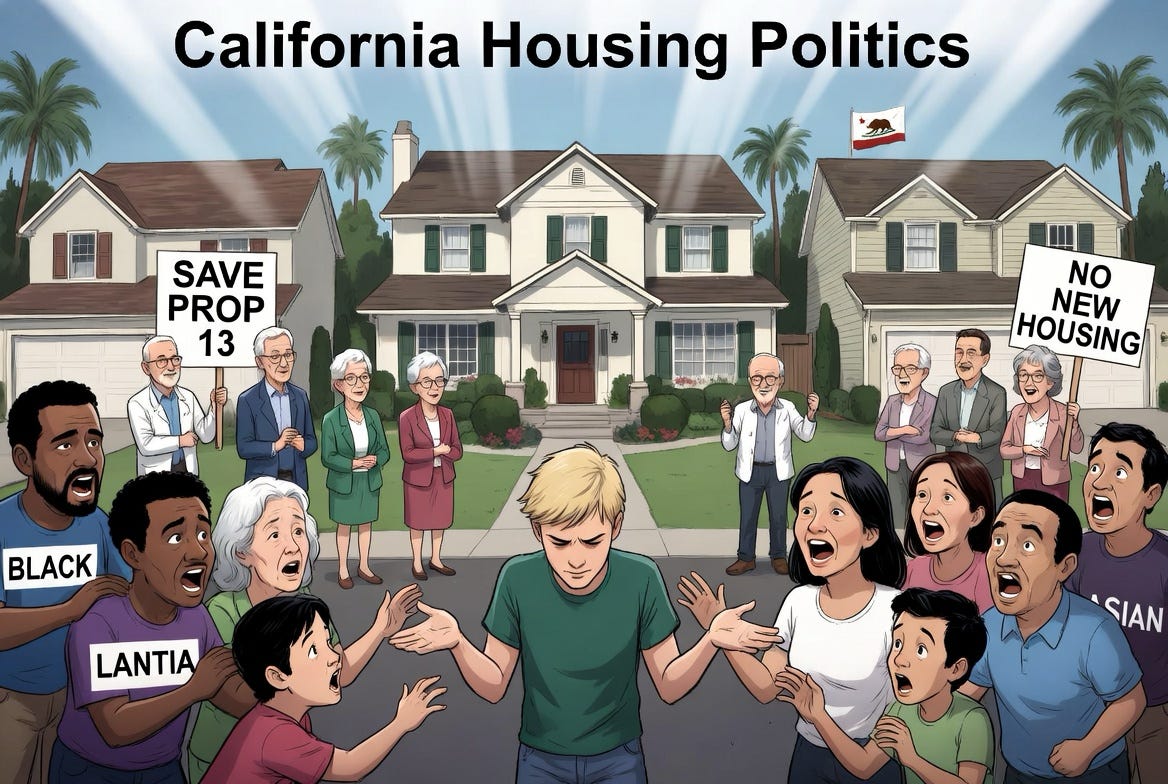
California voters will decide on whether to maintain California’s prop 13, which freezes property taxes at the value assessed when a home was first purchased. The Howard Jarvis Tax Payers Association, which was responsible for the original measure in 1978, sponsored a ballot measure that would require a two thirds vote before any property tax hike, which practically enshrines prop 13 as permanent. However, the Howard Jarvis Taxpayers Association measure is no longer on the ballot in its original form. It was withdrawn as part of a last minute deal with the Legislature and Governor’s office just before the final deadline. In exchange for pulling the initiative, lawmakers approved of a new amendment that focuses narrowly on the two-thirds vote threshold for future property tax hikes. However, the compromise does not invalidate or roll back existing local taxes like LA’s “mansion tax” (Measure ULA). Voters will still decide on the watered down version in November which I will very tepidly support, taking into account the flaws of the current tax system.
Baby Boomers hold the vast majority of housing wealth, as they bought their homes decades ago under much lower prices. Older homeowners have captured enormous unearned gains by benefiting from asset appreciation and from prop 13 tax protections, which widens the intergenerational wealth gap. Millennials and Gen Z, without inherited prop 13 homes, face severe barriers to entry due to skyrocketing prices, high down payment requirements, and competition from cash buyers, including wealthy international buyers from countries like China.
Prop 13 strongly disincentivizes elderly homeowners from downsizing, reducing supply for younger buyers and widening the age-based wealth gap. Homeownership rates in California have declined sharply for younger adults with only 43.5% of Californians aged 25–75 homeowners in 2021, down from 49.8% in 2000 (Terner Center). Only about 19–23% of all Californians (across ages) can currently afford a median-priced home, with White households having only marginally higher affordability (23%), and much lower rates across the board for younger generations. There is also hypocrisy in that boomers voted against the implementation of prop 13 back in the 70s, which was backed by the WWII generation.
While I get wanting to punish the boomers for hoarding wealth and supporting policies like mass immigration to inflate real estate bubbles, stealing from young White people’s inheritance to give to third worlders is a self defeating mindset. A lot of younger White people are dependent on their parents and family’s intergenerational wealth. Thus, seizing boomer wealth to subsidize DEI bureaucrats and public schools for illegals is also stealing from younger Whites’ inheritance. Obviously, soaking the boomers would have a negative impact on younger Whites, especially those living with their parents, who could be displaced from their family’s homes if they are not wealthy enough to afford the homes that would open up.
While the racial wealth and homeownership gap among younger generations remains substantial, it is downstream of the intergenerational gap, as White Millennials and Gen Z benefit more from family housing wealth transfers (down payments, inheritance, cosigning), even if they might be disadvantaged in corporate hiring. Large intergenerational transfers are coming nationally with $124 trillion expected to pass from older generations to Gen X/Millennials by 2048, with real estate being the biggest component. The Left views this as unearned inherited privilege and thus a violation of their equity principle.
Since White wealth is heavily concentrated in real estate, ending prop 13 would essentially be radicalized wealth redistribution against Whites to fund mostly poorer Latinos, who make up almost half of California’s youth population. Boomers are overwhelmingly White while Gen Z and Alpha are overwhelmingly non-White in California. While younger Whites have their own legitimate grievances against the older generation of Whites, a lot of the boomer hate is coming from young non-Whites, which taints the debate. Younger Non-Whites, particularly the college educated cohort, will be the leftist revolution’s instigators and White intergenerational wealth will be their target.


Asians disproportionately pay the most taxes in California, including property taxes, because they have higher median incomes due to job concentration in tech, engineering, and medicine while Whites are older and Blacks and Hispanics are poorer. Thus, you might assume California Asians would be natural conservatives. Since Asians are newer money, they benefit much less from intergenerational wealth transfers that White Millennials have, which they are envious of. Asians, who are up and coming in their careers, see White boomers as strangling their ambitions for home ownership and resent paying more in taxes. Thus, many Asians might view ending prop 13 as a chance to scoop up real estate from Whites. However, there is also a case that Asians and upwardly mobile Latinos could benefit from prop 13 in the long term to build up their own intergenerational wealth rather than trying to steal White people’s birthright. Regardless, East Asian and Indian strivers are increasingly becoming part of the anti-White coalition in California.
Since well off moderate boomer Democrats have a lot of clout in California’s Democratic party (the neoliberal Newsom/Bacerra wing), I think the Democrats plan is to let them keep their wealth and homes in retirement but then after they are gone, go hard after inherited White wealth. This was part of the plan with prop 19 in 2020, which allows seniors to keep their prop 13 protections if they move, but eliminates prop 13 transfers to heirs, eroding intergenerational wealth. It is when the boomers are gone that leftists will takeover California’s Democratic party and push for scrapping prop 13 as anti-White wealth redistribution. However, there is also a lefty anti-gentrification argument for prop 13 in that a lot of older Black and Hispanic homeowners in areas with rising real estate prices would be displaced if it were repealed. This is another reason that Democrats are hesitant to support a full repeal but rather prefer a more targeted approach.


Younger generations of White Millennials/Gen Z, who face higher entry barriers, are delaying marriage, childbearing, and homeownership, which has a major demographic impact. Empty nesters staying put in large homes is a major reason for suppressing White family formation in California because the desirable White neighborhoods with good schools with aging populations have very limited available inventory for even young upper class Whites while the middle class doesn’t stand any chance. You hear about California parents giving up on a second child because of housing costs while the grandparents are living in empty 3-4 bedroom homes that they don’t want to let go of. Prop 19 has had a minimal impact because of the lack of inventory for the elderly to downsize to. This accelerates the out-migration of younger White professionals and families to lower cost states like Texas, Arizona, and Nevada.


Maintaining prop 13 in the short term reduces pressure on the elderly from downsizing which limits family formation by keeping more large homes off the market or priced at a premium, creating a “lock-in” effect. Thus, if prop 13 were scrapped in the short term, a lot of the large homes owned by wealthy seniors would open up for families, which would boost White family formation. However, since prop 13 favors long-term owners over new buyers, ending it may also favor Asian tech wealth and higher-wealth international buyers over younger Whites who can’t compete. Since a lot of affluent White grandparents pay for their grandchildren to attend private schools, taxing seniors more to pay for overwhelmingly non-White public schools may not guarantee a White positive demographic outcome.


Long term, prop 13 benefits White Californians with multi-generational roots and preserves intergenerational wealth transfers through housing equity, which is good for White family formation and helps stabilize White homeownership rates, thus slows demographic displacement. While an imediate repealing of prop 13 might have some short term positive impacts for White family formation in certain affluent suburban areas, in the long term, White Californians are better off with prop 13 in place. Prop 13 being maintained for the short term while being repealed in a decade or two is the worst case scenario because empty nesters still crowd out younger Whites who would miss their fertility window while when prop 13 is ended later there is another wave of displacement and seizure of White wealth, which is a likely scenario if this measure does not pass.
A stock and 401(k) pension crash, which is likely due to debt, inflation, and the AI bubble, might have a similar effect in that it would benefit White family formation through opening up large homes in the short-term while also damaging long-term White intergenerational wealth transmission. A crash would tank equity for owners (many with large homes suited for families) but reduce ability to stay or help adult children form families locally. It might enable a mix of younger affluent Whites and Asians to buy out White middle class boomers. If it coincides a tech crash in which upwardly mobile tech immigrants are laid off in mass, it might be demographically good for the White upper class while still screwing over the White middle class. Also, the elderly downsizing on mass, means they would buy up condos and townhouses, which are the starter homes for the middle class. A more positive trend is that measure sb9 enables large lot homes to be split up so that an elderly empty nester with a large home can build another home on their lot for their relatives. This could add density without displacement while also increasing property values.
Proposal to reform Property Taxation in California

California’s existing paradigm on property taxation has many unique factors including split roll. Besides touching upon many hot button economic and social issues, this paradigm shows that despite being a one party state, California is made up of many different political and demographic tribes, each with their own interests. For instance the ultra-wealt…
The proposed reforms outlined in my article from 2021 were to keep core prop 13 protections for modest middle class homes (<$1.4M), a progressive tax increase scaled on high value homes (phasing out prop 13 protections above $12M), and family oriented tax cuts scaled by number of children/residents to incentivize family formation and generational wealth, delivering substantial property tax cuts to families. This directly encourages higher fertility among groups, both White and Asian, that currently have below replacement birth rates. There should also be tax relief for adults living with their parents or for taking care of an elderly parent, so it is both eugenic and populist and compassionate. Since liberals hate anything pro-natalist, California Republicans should sponsor a ballot measure like this.
I am not for kicking old people out of their homes and I am fine with keeping prop 13 protections for seniors, or at the very least the house rich cash poor middle class elderly. I just don’t think wealthy seniors with both large homes and massive stock portfolios need any more tax relief. California had another proposed ballot initiative that attempted to exempt homeowners aged 60 and older from property taxes that failed to make the recent ballot, which a lot of states are attempting to do. I obviously would have voted against that measure. The political priority should be to incentivize family formation and generational wealth transmission rather than merely locking in the advantages of the geriatric rich. Pure preservation still entrenches the gerontocracy and fails to incentivize family formation or efficient land use.
The key problem with prop 13 is the inherent unfairness in the disparity that a neighbor whose house is worth the same but pays much less in taxes because they lived their longer. However, the counter argument is that it protects long time residents, who are house rich but cash poor, from being forced out of their homes by over taxation. Thus, I proposed a formula that factors in income, home value, and home size to the number of residents. The question besides political feasibility is whether this formula would create an intrusive bureaucracy, including if it is done by some AI technocracy.
The other issue is that there are a lot of under utilized commercial properties, including those with massive parking lots in prime real estate, that create urban blight. I voted yes on prop 15 in 2020 which would have ended prop 13 benefits for commercial properties because I thought it would have led to more under utilized commercial properties being redeveloped into walkable urbanism. My proposed reforms also included taxing underutilized/vacant commercial properties, mega-mansions, private equity investors, and excess vacation homes, all of which could increase supply and turnover. The ballot measure offers full preservation for all properties, including mega mansions of the ultra wealthy, investment and commercial properties, and even golf courses.
I went through a phase where I was interested in the economic theory of Georgism, which you can see the influence of in taxing land waste/underutilization rather than production. I am for taxing waste and inefficiency, which is smart and has nothing to do with leftist equity arguments. However, Georgism would not work in such a low trust, diverse society like California where every tribe is trying to safeguard their own wealth while looking to take from other groups. I favor Distributist economics which is not socialism but rather the widespread distribution of private property, a true ownership society, which is opposed to both state and corporate consolidation of wealth and real estate. Distributists and Georgists would differ significantly in their philosophical foundations and practical approaches to property taxes in California in that Georgism socializes the economic value of land via taxation while leaving legal titles intact while Distributism is more conservative on private ownership but rather is for using taxes and anti-trust as tools to breakdown consolidation and thus spread ownership.
I do not consider my plan to vote yes on California’s billionaire wealth tax to be a contradiction because protecting billionaires is not the same as prop 13 which can protect the middle class. However, you could make the same slippery slope argument that it will lead to a wealth tax targeting the middle class. The reasons I support the billionaire tax is to punish billionaires for their supported policies and to scare billionaires so that they are fighting against bureaucrats and the Left rather than working with them to screw us over. Since Big Tech is a driving force behind immigration policies that displace White Californians, the ripple effects from this tax might mildly reduce the rate of high income Asian tech professionals demographically displacing Whites with generational roots or high paying but non-tech jobs in Bay Area suburbs due to reduced investment, hiring, IPO activity, and stock compensation. The billionaire tax also sort of addresses the issue with taxing mega mansions.
I have become a bit more conservative on these issues than since I wrote that article 5 years ago. If this measure was proposed back then, I may have voted against it. It isn’t so much that my ideology has changed that much but rather that I am less idealistic and more of a realist about what is politically feasible in California. I still prefer my own reform package of targeted cuts and increases but I don’t think it is realistic in the current political climate. We are either going to be stuck with the status quo or a progressive power grab with massive tax increases.
Where I am going to sound more conservative or libertarian is that we need strong safeguards from government abuse, especially in California whose state government is very corrupt. However, my problem with conservative’s slippery slope fallacy, that any taxes on the rich or corporations must be opposed because it will lead to socialism targeting the middle class, is that it is acting on the defensive. The only way to win is to go on the offensive against your political adversaries, which is tough when both conservatives and Whites are a minority in California.
Prop 13 is a bulwark protecting an ownership society and longtime residents against both progressive tax hikes and new wealth (including immigrant wealth). However, this ballot measure is only a temporary defensive measure rather than a positive long-term solution, which is the very essence of conservatism. It offers a tepid defensive shield to protect White Californians long term intergenerational wealth while the trade off is that it risks worsening the intergenerational wealth gap. This is the same argument behind tepidly supporting Steve Hilton in the runoff, who has a very low chance of winning. Hilton has conventional GOP economic planks, such as tax cuts and pro-sprawl development and he is weak on demographic issues, but he could block harmful policies of the Democrats. Young White people are too small of a cohort to really be a powerful force on their own, especially in California, so I get why a candidate like Hilton would try to appeal more to the elderly and Latino and Asian small business owners than young Whites.
Maintaining prop 13 may slow the pace of demographic change in suburban areas but does not reverse the broader shift toward higher Asian and Latino shares in California and an overall declining White share in the same way that nimbyism does. This buys time for White family formation and slows the erosion of intergenerational wealth for those who already hold property but does not solve underlying issues like housing supply shortages, high costs of living, delayed family formation among younger Whites, and continued pressure from both domestic out-migration and high-wealth international inflows.
R.S. makes a good point about how Georgism would most likely require a homogenous society to function; I had not considered this factor before. I remember hearing about the Georgist land system on Scott Alexander's ACX blog some time ago and finding it intriguing; I'm guessing that some portion of the ACX community would not want to discuss why this system would probably fail in America.
My nonagenarian uncle pays MUCH lower property taxes than I do even though his house is worth multiples of my condo. Okay I get that most old people are on a fixed income but he’s got a great pension and plenty of money. I hesitate to aggressively tax them or implement something like means testing but I get the resentment. My daughter and her husband pay like $3000 for a dumpy 2br apartment. Boomers and older also don’t want lots more housing as a rule so in some sense they pulled the ladder up behind them and made it harder for younger folks. Like this guy who is so annoying. https://thevoicesf.org/the-nimby-tyrant-of-telegraph-hill/