The Metaphysics Of My New Religion: Cosmoplatonism

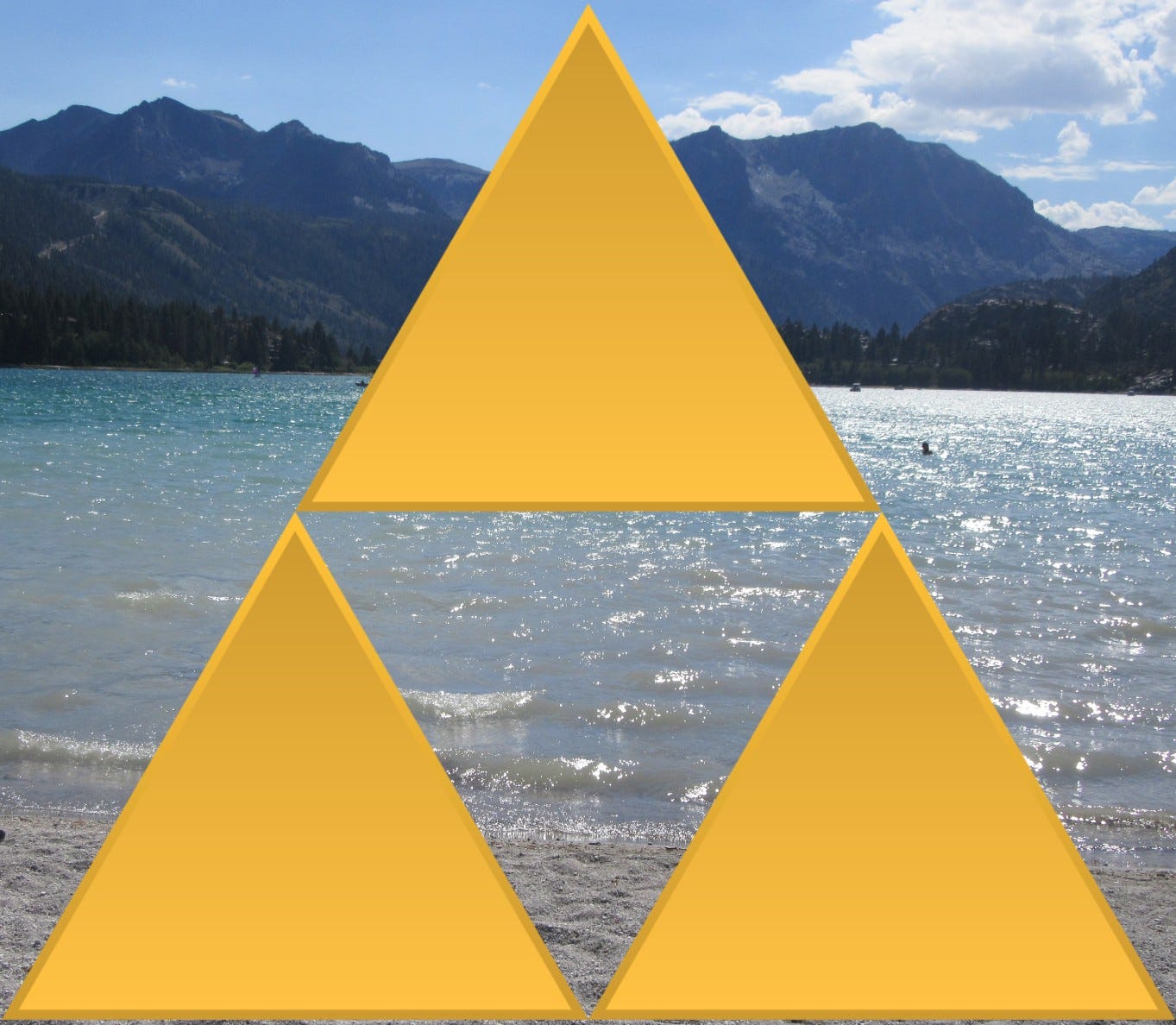
(The Triforce overlaid over my photo of June Lake, where I had a mystical experience, represents the Divine Source at the top supported by the Divine Consciousness and the avatars)
Hypothetical names for the new religion: Cosmoplatonism, Cosmotheosophy, Cosmotheism, Cosmotheology, Cosmodeism, The Church of Divine Science, and The Church of Divine Emanations. I am leaning toward Cosmoplatonism, as it implies expanding from where the Neoplatonists left off. My next preference is the Church of Divine Emanations, though it sounds too much like a 70s cult. I am leaning against Cosmotheism because it is associated with White Nationalist William Pierce.
I have been talking about starting a new religion for the past several years. I prayed intensely about any doubts I had about whether I was doing the right thing by starting a new religion and I feel good about it. The theology of Cosmoplatonism is based on my intuition, contemplation, observations of philosophy, psychology, and nature, and research of near death experiences.
Cosmoplatonism is not a dogmatic doctrine but rather is a process of spiritual discovery, the quest for spiritual knowledge or gnosis, and a philosophy to greater understand the Divine. Cosmoplatonism must offer answers to not just the existential questions but address the current social crisis, and the future of the Earth and humankind. I predict another religious revival and rise in cults over the next few decades in response to existential issues like societal breakdowns, ecological destruction, and the rise of AI.
Neoplatonism: Neoplatonism was a philosophical and religious movement that emerged in the Roman Empire in the 3rd century AD founded by Plotinus.
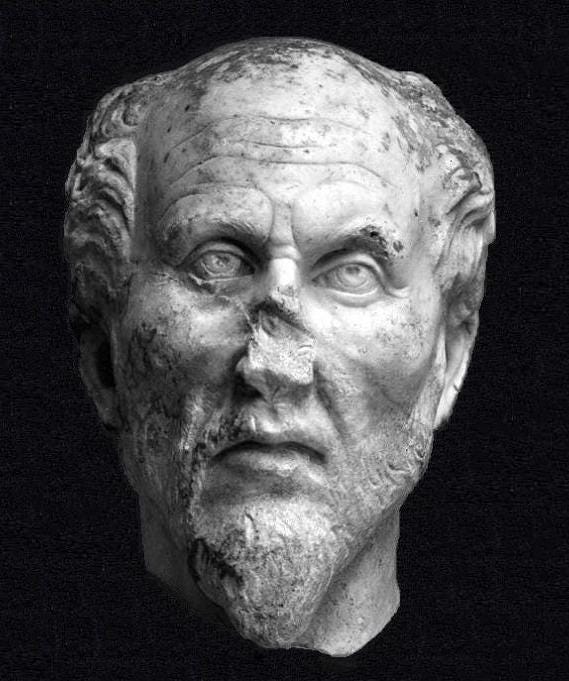
Head in white marble. The identification as Plotinus is plausible but not proven (wikipedia.org)
Emanation: Neoplatonic concept that all things in the Universe "flow" or "proceed" from a single, transcendent source, which is reflected in nature such as sunrays and water cycles.
Apophaticism: Neoplatonic concept that the nature of the Divine is beyond human comprehension. For instance, I have no idea how the Divine source came into being and how it has existed for all eternality. Another example is Neoplatonic interpretations of Christianity or Islam, which believe that Christ or Muhammed received this Divine light that was incomprehensible to humans, thus they had to translate that Divine message into a doctrine that is comprehensible to humans.
Theurgy: Neoplatonic concept that means "divine work" or "divine action,” which originated from the Neoplatonic philosopher Iamblichus. Theurgy has influenced Christian sects, particularly Eastern Orthodoxy and Catholicism to a degree though Protestants strongly reject it as pagan idolatry. Theurgy is separate from good deeds to bring one closer to the Divine, which is also important. Theurgy is about using ritual and aesthetics for spiritual purposes, including art and music that create a strong emotional or spiritual response. Using aesthetics to increase beauty in the World can bring us closer to the Divine by heightening our consciousness.
Example of the principle of emanation in music:
Pantheism: All life has a divine emanation, even if a plant or even a rock formation might not have consciousness. Beauty is a heightened emanation from the Divine as it stimulates similar spiritual receptors as a deep religious experience. I reject the gnostic view of totally rejecting the physical world. Like the Neoplatonists, I consider the physical world to be an emanation of the Divine like a photocopy. While nature is a higher emanation, there is still value in human creations. Objects become sacred if given meaning by people cherishing them like with Shintoism. It is not idol worship of objects but rather that our consciousness illuminates them with divine energy.
There are three forms of beauty; natural beauty represented by the avatar Gaia/Terra, the human beauty that inspires romantic desire represented by Eros/Cupid, and manmade beauty such as music, art, and architecture represented by Prometheus. Combined, these forms of beauty represent one emanation from the Divine source. While natural beauty is a higher emanation, manmade beauty is important nonetheless.
Sexuality & Romance: Sexual/romantic desire can be broken down metaphysically as reproduction, consciousnesses, genetic causes for beauty, and hormones; fusing the biological with spiritual emanations. This is what Carl Jung called the Anima, which is the emanation responsible for romantic desire. Sexuality and romance expand consciousness as an escape from the mundane. When someone is feeling numb, and they see someone they sexually desire their senses are heightened. Plotinus believed that every desire is a need of the soul projected onto the external World.
However, being enslaved to lust can prevent one from reaching a higher level of consciousness, and enslave one to the Demiurge, as one conforms to society or chases status to gain sexual access. Regardless, the main downside of encouraging celibacy is spiritual dysgenics of the most spiritual people not reproducing. Thus Cosmoplatonism is simultaneously sex-positive and sex-negative, as sexuality represents a middle tier of consciousness.
Asceticism: Asceticism is turning away from the material world and abstaining from worldly pleasures to focus on spiritual growth. However, asceticism does not have to be about great sacrifice or suffering but rather to purify one’s consciousness from unhealthy substances and activities, ugliness, and separating oneself from all that is bad about society. For instance, rejecting excessive amounts of alcohol, junk food, excessive meat consumption, crass consumerism, and entertainment, while taking in aspects of the material world that are uplifting. It is also important to set aside time for contemplation.
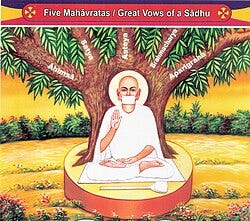
Five Vows (mahāvratas) of Jain ascetics (Wikipedia.org)
Theosophy: Theosophy, a spiritual movement started by Helena Blavatsky, believes that there are many spiritual paths to the Divine. Theosophy is backed up by the emanation principle, in that the highest Divine truth resides at the highest levels of emanation closer to the Divine source. However, from lower emanations, we may still gain hints about Divine truths. Thus, many of the World’s religions contain some partial divine truths, despite being tainted by human corruption, abuse of power, and psychology that is shaped by the ego rather than attuned to the Divine.
Helena Blavatsky

source: Wikipedia.org
While Theosophy accepts that all religions point to some Divine truths, an egalitarian Theosophy that believes that all religions are equal makes no sense. There is a hierarchy as far as which religions are closer to the Divine and which are fabricated by man which is open to debate. Certainly, we have our biases, both ancestral and to which religions speak to us more personally.
Bio Deism/The Spiritual Genome: How each religion was formed reflects how each group’s genetics and evolutionary adaptations respond to divine emanations at a particular point in history. So when Christians say Christ is the truth, they may very well be right, but if that true divine light behind Christ emerged in another place and time and among different people, Christianity might look very different. This is because genetics create different spiritual archetypes that are drawn to a particular theology.
In contrast with creationism, evolution reflects emanation. Since there is a genetic code that makes people more spiritual, there are both spiritual eugenics and dysgenics. This is not necessarily about IQ or race but about how certain people are more spiritual than others due to their genetics. Even an atheist might still have some underlying spiritual component to their genes that draws them to nature. Certain people are more emotionally and spiritually moved by certain things like music, art, or nature, or from pro-social acts versus inner contemplation, and these traits are often shared by people who are related. Thus assortive mating among spiritual people can strengthen genetic traits for spirituality. Regardless, all life is an emanation from that Divine source and thus is interconnected. Compassion for outgroups or animals proves the Divine, as if we accept a Darwinian reductionist view then the genocide of outgroups without remorse would be the rational norm.
Spiritual Science: A belief that science and spirituality are fundamentally interconnected, rejecting both creationism and secular scientism. Science is more effective in proving the Divine than religious dogma. For instance, the complexity of life forms and how the Universe came into existence. In particular, neuroscience will have great breakthroughs in understanding the nature of consciousness, including near death experiences.
Consciousness: Consciousness is an emanation from the soul, that is an emanation from and interconnected to Divine consciousness. Consciousness is a light that can dim and needs to be relit which is analogous to how the Sun and other stars dim and become bright again, expanding and contracting. As we get older, time goes by faster and our senses dim but we can counteract that and continue to expand our consciousness by having new experiences. A dimed consciousness where one just goes about their day on autopilot without feeling alive or being the robot as author Colin Wilson put it, is not fully in tune with the Divine.
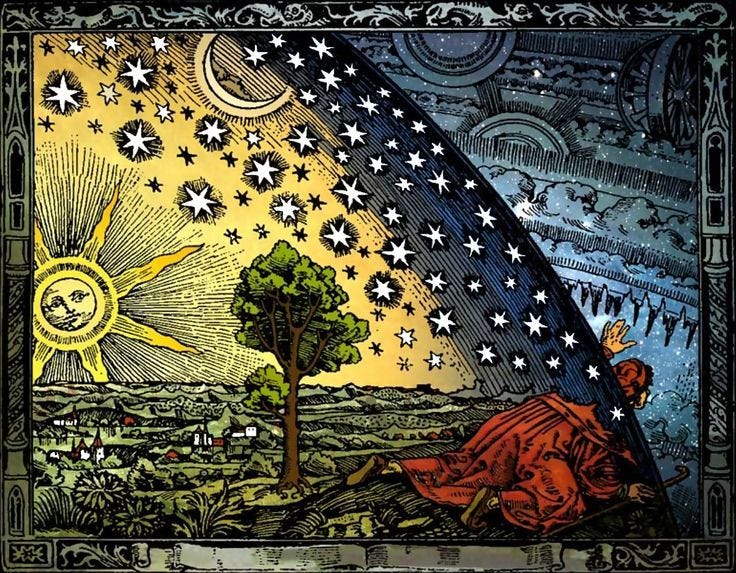
Suppressing one’s subconscious or Jungian shadow self is responsible for a lot of problems with politics, religion, culture, and society. Thus part of reaching a higher stage of consciousness is tapping into hidden truths and unresolved issues in our subconscious. While many believe that civilizational decline is part of an inevitable cycle, which many religions believe, this cycle is a product of a decline in consciousness that can only be escaped by humankind reaching a higher stage of consciousness. We also pass down consciousness to the next generation through reproduction. Some spiritual growth is passed down but also dimed and in need of being relit by the next generation.
The Sufis, who are basically Islamic Neoplatonists believe that most of humanity spends their existence on lower rungs of consciousness. According to Sufism, these different levels of consciousness are The Level of Beliefs, The Level of Social Contracts, The Level of St. Ego, The Level of Philosopher/Charlatan, The Level of Despair, The Level of Suicidal Panic, The Level of Here and Now, The Level of Pure Reason, The Level of Teaching, The Level of Bliss, The Level of Communing with God, The Level of Ongoing Conversation with God, and the highest being The Level of Reunion, which is the disappearance of the self and reunion with God after death.
Ethics, Morality, and Good vs. Evil: Evil comes from being in the shadows further away from the Divine Source and a lower level of consciousness. A lack of empathy comes from being disconnected from others’ consciousness. However, people engage in depraved sexual acts or commit violence to heighten their consciousness to escape that dim feeling. They just lack the spiritual prowess to ascend to a higher level of consciousness. A lower emanation being more intense sounds convoluted but an explanation is that layers of emanations are like the patterns in ripples in water, where a ripple further out might have a stronger hue of color intensity.
Morality and ethics also follow the emanation principle, with the highest morality being universal or divine morality, which applies universally. For instance, it is wrong to cause harm to another person or being without cause. The next layer of morality is conditional based on circumstances and genetic/biological factors. For instance, in a conflict where there is no clear aggressor both sides may be justified in fighting for their group interests.
Prayer: Prayer and spiritual contemplation are important for communicating with the Divine to seek spiritual guidance, purify the soul, and become closer to the Divine. The objective is to achieve a state of oneness or alignment with the Divine Source. Like Christianity, I believe that people can have a personal relationship with Divine Consciousness.
The Divine Source: Since the Divine mirrors natural cycles, the Divine Source is like the Sun or a spring where light or water that sustains all life originates. The Divine Source is the ultimate truth or “The One” as Neoplatonists call it. It is the ultimate origin and fundamental reality from which all things arise. It has existed and will exist for all of eternity, as it is beyond our comprehension of time and space.
The Divine Consciousness: The Divine Consciousness or Divine Spirit is analogous to the Holy Spirit in Christianity, and is how humans and life on Earth communicate and interact with the Divine. The early Christian theologian, Origen, was the first to talk about the hypostatical distinctions of the Trinity and was heavily influenced by Neoplatonism.
The Divine Source and the Divine Consciousness are not separate deities, as they are both God. The Divine Consciousness is heightened awareness and connection with the Divine Source. The Divine Source is analogous to the Sun while the Divine Consciousness is to the process of photosynthesis in how sunlight creates life on Earth. Many near death experiences mention this distinction, as far as seeing this powerful ethereal light which is the Divine Source, and then communicating telepathically with the Divine Consciousness.
The 6 Avatars: An avatar is not a deity but rather an emanation from the Divine, which can symbolize important concepts and take on physical or elemental forms. Together these avatars are a complete divine emanation, but there is some hierarchy in the importance of the avatars that complement each other while offering different archetypal paths. There are also sub avatars like for Prometheus, avatars for science, music, and visual arts, and Gaia/Terra for plants, animals, geological formations, the Sun, the Moon, and the cosmos.
Christ/Krishna/Mithras: Avatar representing platonic and familiar love, forgiveness, compassion, mercy, humility, healing the sick, and assisting the soul to ascend to the afterlife. This avatar is especially important because of the role in ascendance to the Divine realm.
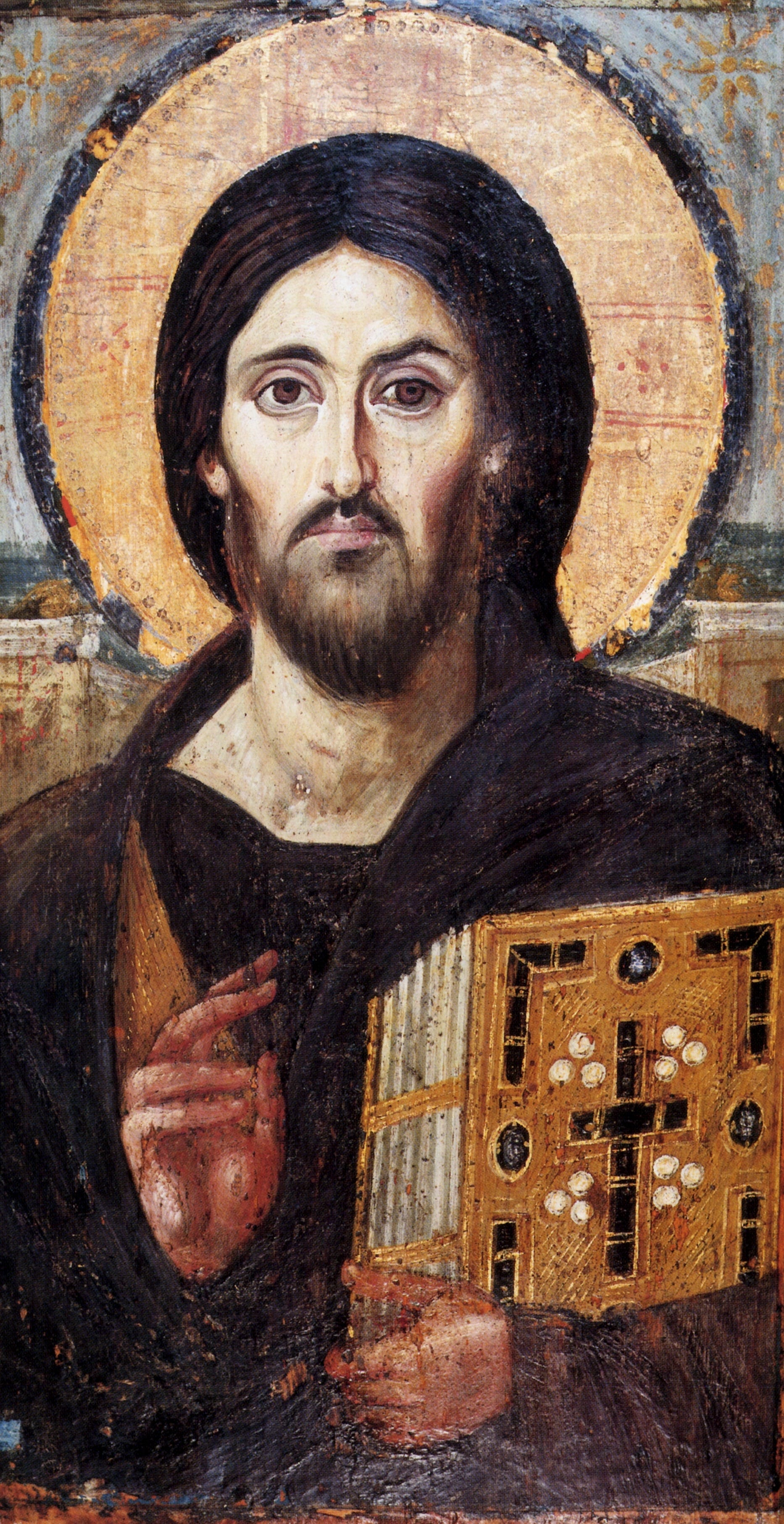
The Christ Pantocrator of Saint Catherine's Monastery at Mount Sinai, 6th century AD via Wikipedia.org
Gaia/Terra: Avatar represents spirituality and inner peace experienced in nature, guardianship of the natural and animal world, and a reminder that man is connected to other life forms on Earth.
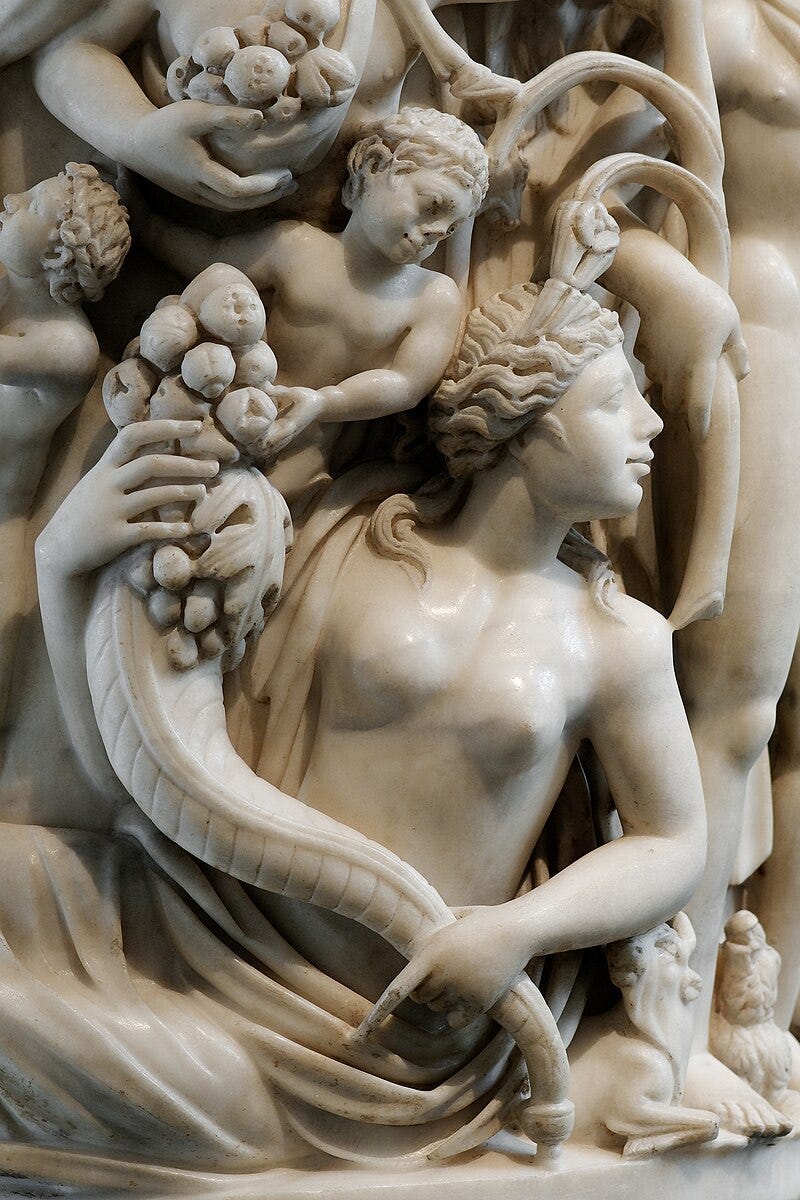
Detail from a sarcophagus depicting a Mother Earth figure (3rd century AD) via Wikipedia.org
Prometheus: Prometheus is the Greek Titan who gave the fire of the Olympian Gods to mankind. Prometheus is the avatar that represents techne, knowledge of arts and science, innovation, creativity, exploration and discovery, and the long-term destiny of mankind, such as space travel and terraforming.
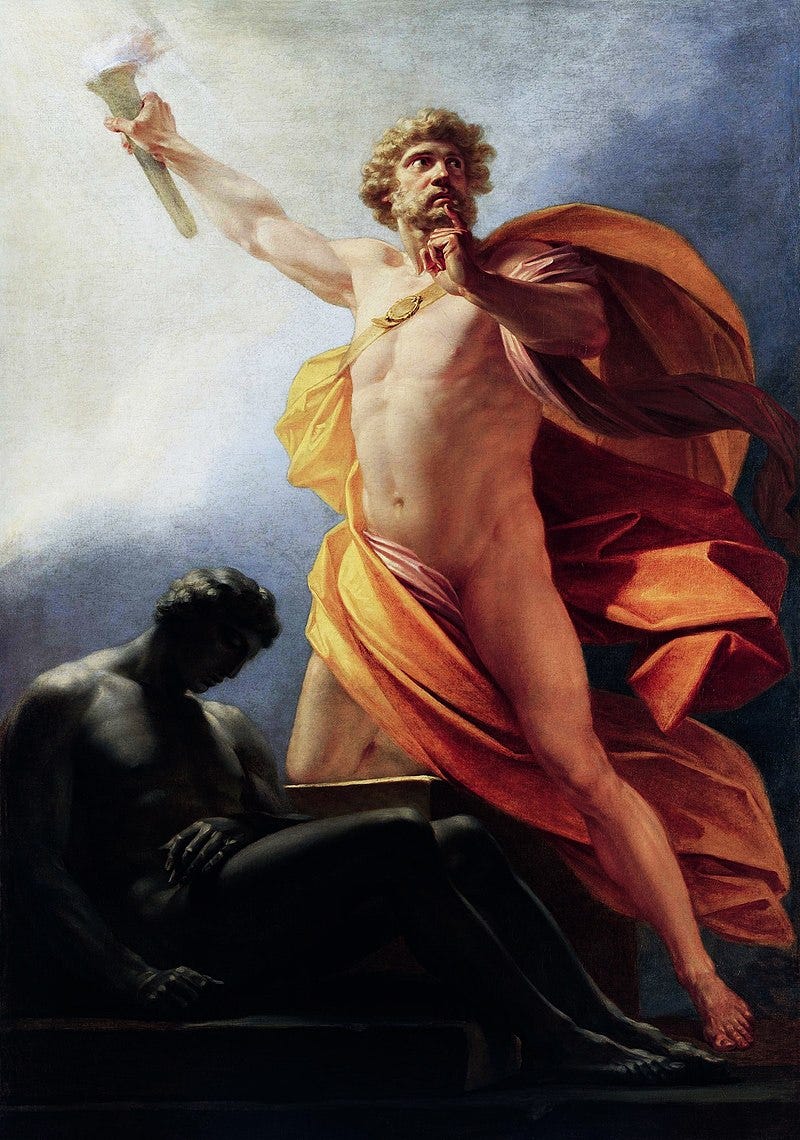
Prometheus Brings Fire by Heinrich Friedrich Füger (Wikipedia)
Eros/Cupid: Avatar representing romantic love and sexuality.
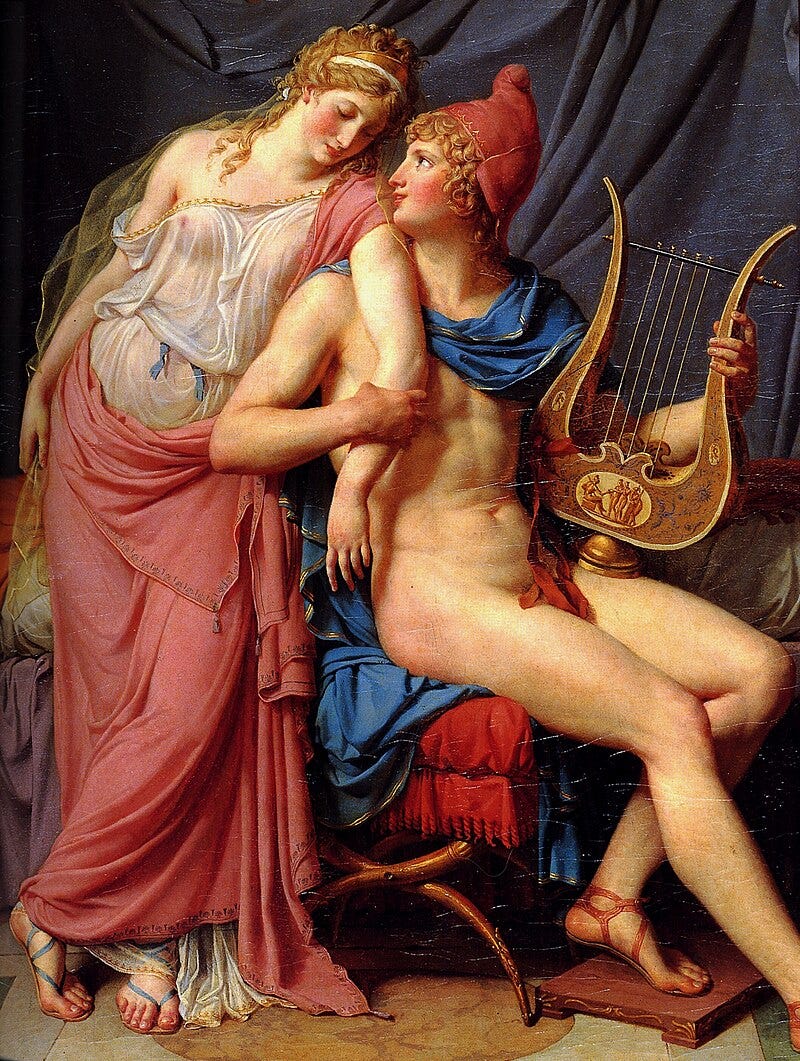
The Love of Helen and Paris by Jacques-Louis David (1788) via Wikipedia.org
Ares: Avatar of strength, courage, and overcoming adversity.
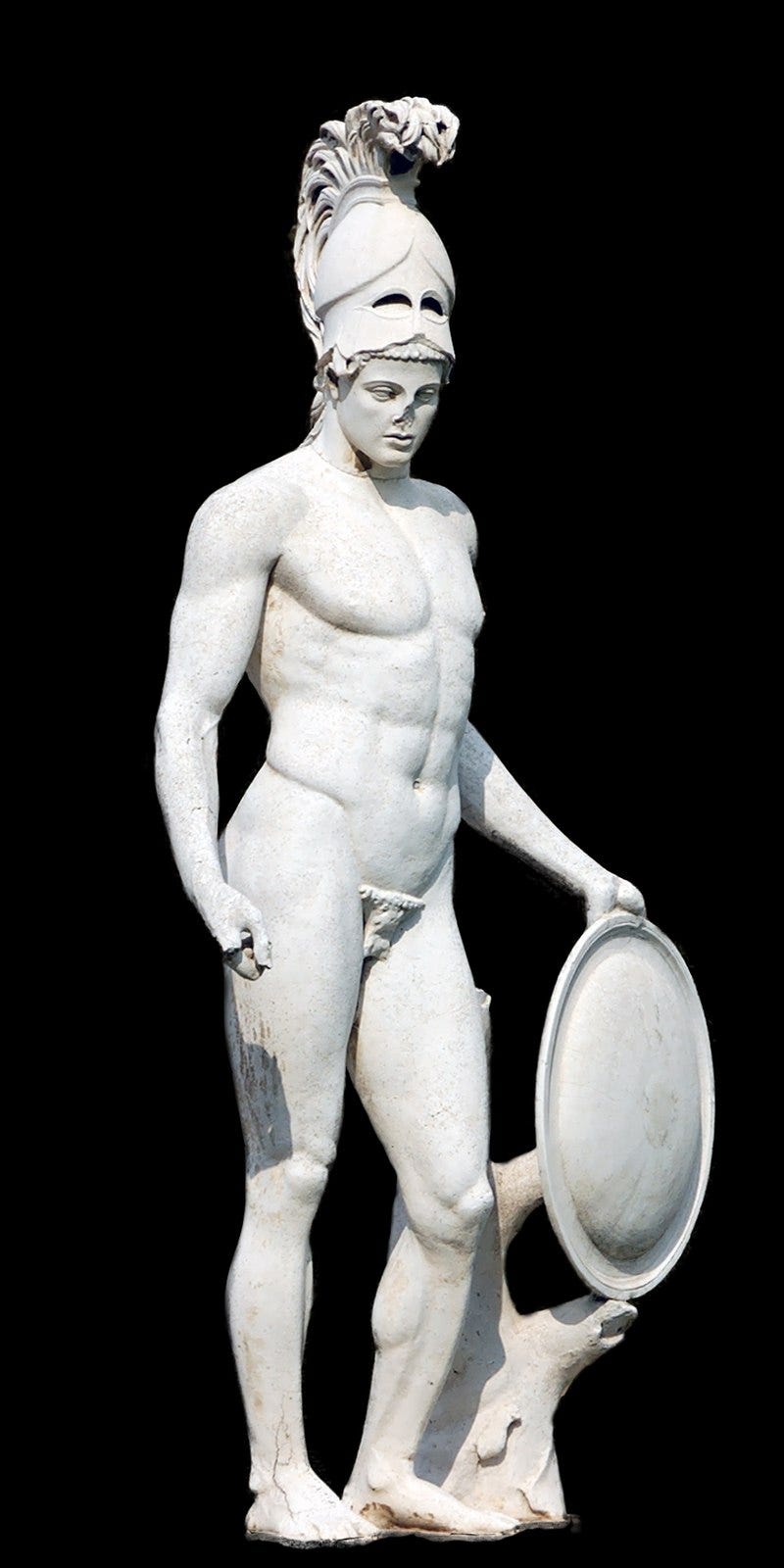
Cast of a Roman statue from Hadrian's Villa, copied from a Greek original. Traditionally identified as Ares or Hermes. (Wikipedia.org)
Ancestral Avatar: This avatar represents remembering history, ancestry, and how spirituality intersects with genetics. Genealogy is important because a continued genetic lineage is a spiritual line that connects the future to the past. This gives greater meaning to one’s life but also to people who have died by remembering their names. There is a saying that the 2nd death is after the last time someone says your name. This is also important because spiritual traits are passed down through genes as well as an ancestral consciousness.
The Demiurge: The Demiurge is not the lesser deity that Gnostics describe as enslaving mankind. Rather the Demiurge is a metaphysical prison created by the masses of humans with an inferior consciousness. This spiritual enslavement comes from fear and exploitation-based systems, ideologies and theologies, demoralization, gaslighting, conformity, and even just an acceptance of the mundane or status quo. Lower consciousness people suppress those who are spiritually enlightened, economically, politically through mass democracy, culturally, socially, and spiritually.
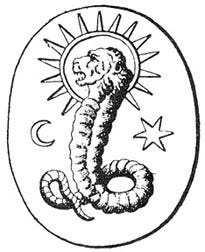
A lion-faced, serpentine deity found on a Gnostic gem in Bernard de Montfaucon's L'antiquité expliquée et représentée en figures, a depiction of Yaldabaoth. (Wikipedia.org)
Social atomization has a spiritual dimension, as consciousness becomes atomized, and collective consciousness is diminished. However, both social atomization and the kind of forced socialization that forces people to socialize or submit to people with lower consciousness that is found in institutions like public schools and corporations crush the soul. People need to spiritually detach themselves from institutions that function as the Demiurge, even if they still have to take part in them to survive.
The Afterlife: There is a scientific case for the legitimacy of near death experiences (eg. the subject is clinically dead, experiences are more vivid and intense than mortal life let alone any dream or hypnogogic experience, and knowledge of events that occurred while the person was under). While near death experiences have commonly shared themes such as a tunnel of light, a life review, and telepathic communication with the Divine, the differences are in religious symbolism. Not to mention that NDE’s can contradict theologically as far as the nature of salvation, which brings us back to the question of apophaticism.
The emanation principle is the strongest justification for universal salvation or reconciliation, as early Christian Neoplatonist theologian Origen believed. While we may experience temporary separation from the Divine in this world and perhaps after death, since everything emanates from the Divine Source then everything must eventually return. However, the soul has to be purified before being reunified with the Divine Source. It is analogous to the water cycle of how sewage water or a polluted stream must complete a cycle of purification to become drinking water through condensation and precipitation. Also, how a dead body decomposes and enriches the soil for plant and animal life.
A new religion? It seems to me that you actually want to establish a new branch of science. A science of consciousness. That would make more sense to me. It encompasses all religions.
Every religion has its mystics. And mysticism is nothing more than divine experiences of consciousness. Cataloguing these and searching for commonalities or possible laws seems worthwhile to me.
This would allow you to connect all religions and, in the best case, find a universal truth.
See also:
https://annakaharris.com/
https://www.bernardokastrup.com/
I percive that when you tried to describe pantheism you just went on describing neoplatonism and theurgy. Worshiping the transcendent god in matter. Either through prostrations, icons, singing, ect is not pantheism. Neither is seeing the beauty in all things. Pantheism is the rejection of transcendant reality because by definition it is uncreated therefore not existant. They conflate being with existance. Only read up to that point but so far you just seem like a platonist.